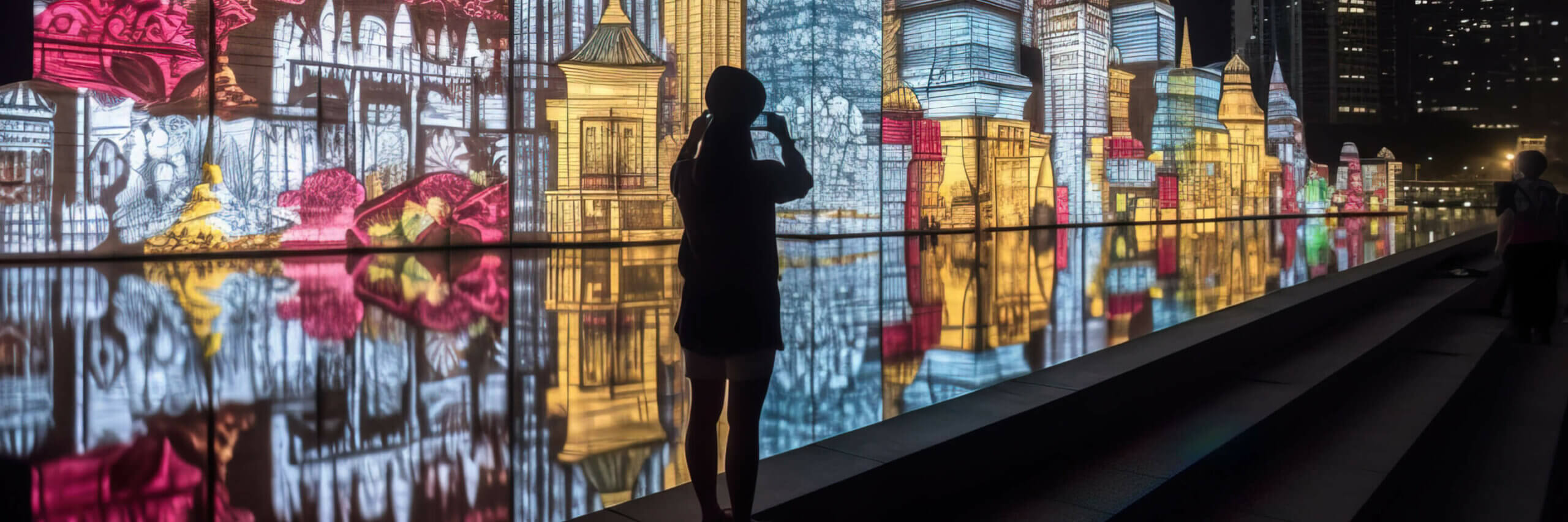
For years, we’ve been told that brand assets are static. A product on a shelf is just a product. A billboard is just a picture. This thinking is outdated. What if those assets could become dynamic, interactive stages for your brand story? The key isn’t just adding tech; it’s making the tech disappear. When done right, technology becomes the silent enabler of a memorable experience, turning passive viewers into active participants. In this piece, we’ll break down a few brilliant invisible technology examples that show how projection mapping, holograms, and 3D screens are bringing formerly static objects to life and creating real commercial value.
Whenever someone says “tech,” or I say the other part of my job is “technology,” I see scared faces, likened to that of a deer in the headlights of an oncoming car. The reality is technology doesn’t have to be scary! On the flip side, everybody also likes to think they know technology, even my mum “knows” technology because she is on Facebook and Instagram posting pictures of her dogs or super embarrassing ones of me and my brothers in the 80’s with permed mullets, but that’s not tech. That’s an experience, the technology and/or innovation is what makes the experience, and, in my opinion, the best technology is invisible to the consumer. It’s the same with your mobile phone — you wake up, turn off night mode, and look at the news, and if you are British, the weather app, enabling you have something to post on your next app, which most of the time is a social media platform. Have you ever thought of all the technology that goes into your little morning wake-up routine? The news is pulled from multiple servers globally to give you the latest up-to-the-minute updates, aggregated, then displayed on your mobile. The same process with the other apps, but with added complexity of serving advertisements linked to your personal history from many databanks. I’m not even going to touch on what I think the future will be like with AI.. that’s a whole other article. In other words, the consumer of the technology isn’t interested in how it does what it does, they are interested in what it does. The next three examples showcase how technology is used in a creative way to enable an idea. I’ve put them under the headings of commerce & retail, packaging, and out of home.
From Store Shelves to Interactive Showcases
The first example is projection mapping, which is the ability to take an object and project images onto it. We have all seen the amazing light shows where they project stories onto building like below. This next example is using that same technology but on a smaller scale to connect with commerce. In-store you have a plain sneaker on shelf. Using projection mapping, you can see that the full product range, color, and patterns are all able to change right in front of you. All on one sneaker. Currently this example is just projecting on the sneaker, but let’s take this case a little further… Do you remember Nike ID, which is now Nike By You, where you customize your sneaker? What if you were able to self-express and design the sneaker, live, then order from the store to be delivered to your home? The consumer doesn’t see all the code and hardware it took to make this happen. They see that they can swipe through all the designs and customize on live tangible products. A memorable / shareable experience. Projection mapping is normally all show and no functionality, but this new example could enable direct purchase in-store, giving a unique consumer experience.
When Packaging Becomes the Experience
When you are working in the CPG category you will have to also design the packaging for your product. The requirements are many, but a few simple rules apply:
- The product must be stand out on shelf.
- The product must be engaging in hand.
- Bonus points if the product is shared and discussed in this world of word of mouth and social.
A lot to ask from what is, in most cases, a piece of cardboard with a good design on it. Enter stage right… technology. With technology, you can transform what was “just” a beautiful design into something engaging and interactive. To clarify, I am not at all underplaying the importance of design with the above statement. In fact, design in the broader sense is the core. When people think packaging and technology, they normally go straight to two technologies. Today I will not talk about QR codes, as this technology was invented way back in 1994 with mass adoption in 2010 – though still a great tech in my humble view. I will not talk about AR either, although AR is now being adopted even more with new devices and xR opening the possibilities to engage, entertain, trade and sell. I will leave xR and mobile technology to another article. This example uses holograms! Yes! It’s like watching a magic show. The brand Bombay Sapphire was one of my and my talented team’s projects from 2016. The technology is the enabler, using existing hardware and the innovation of the packaging itself makes the magic. A little bit of filming wizardry to make the actual hologram. Using some clear plastic inside the packaging we create what seems like mirrors to reflect, then using your mobile phone (existing tech) with the packaging we can produce the illusion that the hologram is actually inside the bottle. (Disclaimer: the liquid must be clear like water.) What would have normally been a product leaflet left on the bar or in the office informing bar keepers on the product taste cues etc., was now a consumer experience that delivered the story in a compelling and engaging way. The product was then left on the bar for consumers to engage with the product and, in turn, order. This combined packaging innovation, mobile technology, and production technology to produce an engaging brand experience that connects directly to purchase. This was 2016, let’s take this case a little further… Using AI (which I said I will not go deep on in this post), we could have the hologram not just tell a story, which is already pretty impressive, but we could talk to the hologram, interact, and even place an order. If you have time, watch the case film to see the hologram in full glory.
Billboards Are No Longer Just Background Noise
Out of home (OOH) advertising has, for the most part, been a two-dimensional medium with one-way communication. This has changed over the past years and now there are billboards you can actively engage with, like the Becks beer out of home posters [i] which you can plug into while waiting for public transport and play music or the British Airways Live billboard [ii] linking to the planes flying overhead informing you, what the flight number is and where the plane is heading via a massive OOH in Trafalgar Square in London. What was once the medium of just static images, is now a place where brands can engage, entertain, and even gather data. The final example is the 3D billboard in South Korea that takes the storytelling and engagement to another level. The billboard comes to life with waves, trains, and animals all “breaking free” of what are normally the restraints of the once print-only medium. Using 3D screens and smart filming the consumer has the illusion that what is in this 3D cube can break out. A truly shareable and memorable experience for a brand. If you have time, please watch the film in the link to see the power of this 3D medium. Taking this case a little further… with the adoption of many geolocation couponing apps hitting the market, it would be an easy win to add the 3D experience as a way to unlock further discounts and experiences. What these three examples have shown is that using technology as an enabler will lead to better engagement, interactions, and experience, which leads to data-gathering and sharing, which generates bigger and better brand awareness and conversion. Don’t fear technology — embrace it. There are plenty of experts out there to help you navigate what seems like a minefield of acronyms, experts to sort the zeroes and ones. It’s these sorts of ideas that we need more of to bring brands to life in the consumer’s hands. Or Consumer ready magic as we like to call it at Vivaldi.
See It in Action:
[i] Becks Beer Poster: https://fabnews.live/becks-creates-playable-poster-in-support-of-new-zealand-music-month/ [ii] British Airways: https://www.wpp.com/en/featured/work/2018/06/ogilvy-uk-british-airways-magic-of-flying
Frequently Asked Questions
What do you mean by “invisible technology”? Think of it this way: when you use your phone to check the weather, you aren’t thinking about the global servers and data aggregation making it happen. You’re just getting the information you need, seamlessly. That’s the goal for brand experiences. The technology should be the silent engine that powers a moment of magic for the consumer, so they focus on the experience itself—customizing a shoe or interacting with a story—not on the code or hardware behind the curtain.
These examples seem like big, expensive projects. How can a brand start applying this thinking on a smaller scale? You don’t need a massive 3D billboard in Times Square to make an impact. The core principle is about turning a static asset into a dynamic one, and that can be done in simpler ways. It could be an interactive display in a single store that lets customers explore product features, or a clever packaging design that reveals a digital story when scanned. The key is to identify one touchpoint and ask how technology can make it more engaging, rather than trying to overhaul everything at once.
How do you connect these creative experiences to actual business results like sales? These interactions are designed to be a direct bridge from brand engagement to a commercial action. The projection-mapped sneaker, for example, isn’t just a cool visual; it’s a tool that could allow a customer to design their own shoe and place an order right there. The holographic packaging was created to be left on the bar, sparking conversations that led directly to drink orders. The experience itself becomes the most compelling part of the sales pitch.
My team isn’t very tech-savvy. How can we start thinking this way without getting overwhelmed? The best approach is to lead with the creative idea, not the technology. Instead of starting with, “What can we do with AI or holograms?” begin by asking, “What’s a more compelling way to tell our brand’s story?” or “How can we make our product come to life for a customer?” Once you have a strong concept rooted in what you want the customer to feel, you can bring in technical partners to help figure out the execution. This keeps your team focused on the strategic goal, not the technical jargon.
How do we choose the right technology for our brand’s story? The story should always choose the technology, not the other way around. Start by defining the specific experience you want to create. If your goal is to showcase a wide range of product variations in a limited physical space, projection mapping is a natural fit. If you want to convey a complex brand history in an intimate and memorable way, a hologram might be perfect. The right technology is the one that feels like an authentic and powerful extension of your core message.
Key Takeaways
- Make the Technology Disappear: The most powerful brand experiences happen when the consumer is so engaged in the interaction that they don’t even notice the technology enabling it. Focus on creating seamless, intuitive moments that feel like magic, not a complex system.
- Transform Static Assets into Interactive Stages: Your products, packaging, and even billboards are no longer just static objects. Use creative tech like projection mapping and holograms to turn these physical touchpoints into dynamic platforms for storytelling, customization, and direct engagement.
- Connect Engagement Directly to Commerce: An impressive tech application is only half the battle. The real value comes from linking that “wow” moment to a clear commercial action, whether it’s customizing a product for purchase, unlocking an offer, or capturing valuable consumer data.
Related Articles
- Invisible Technology That Creates Consumer Magic – Vivaldi Group
- Retail Branding: Top Strategies for Success in a Competitive Market
- The Best Strategies for Effective Brand Innovation in Today’s Market
- Reinventing Brand Strategy: The Holistic Brand Model – Vivaldi Group
- AI in Retail – Is the Value Real or Artificial? – Vivaldi Group