
An executive from L’Oréal recently made a bold claim: in the age of AI, the biggest companies will win. Why? Because they have the data. This simple statement cuts through the noise, revealing a fundamental truth about the new competitive arena. Data is the fuel, but it is inert without an engine powerful enough to convert it into value. That engine is AI. The strategic challenge, then, is not merely to collect data, but to deploy AI in a way that creates tangible advantages. How do you move from organizing information to reimagining entire customer experiences? The Vivaldi AI model offers a structured answer, detailing a path from leveraging data for productivity to building interactive ecosystems that generate network effects and lock in market leadership.
The burgeoning enthusiasm for Artificial Intelligence (AI) in recent years and months has become palpably evident, especially in major conferences where it has dominated discussions. Events like the World Economic Forum in Davos and the Consumer Electronics Show (CES) in January of this year have become prominent platforms showcasing the transformative potential of AI. At these gatherings, global leaders, technologists, and innovators converged, sharing insights and forecasting the far-reaching implications of AI on businesses, brands, and society at large. In Davos, for instance, the conversation often centered around the socio-economic impacts of AI, encompassing its potential to drive productivity, growth and innovation while also addressing concerns about job displacement, responsibility, inclusivity and ethical considerations. Similarly, at CES, AI’s influence was seen in a more practical light, with a focus on its integration into every imaginable consumer product, and how it’s reshaping industries from automotive to healthcare. The pervasiveness of AI-related topics in these conferences and others signals a recognition of its integral role in shaping our future, and the potential to revolutionize entire industries.
Are We in an AI Bubble? (And Does It Matter?)
The current buzz around the “AI bubble” can be contextualized by looking back at the emergence of two transformative technological eras: the internet and the mobile and social media revolution. Each of these periods marked a seismic shift in how consumers and companies interacted with technology and with each other.[1]
- The Internet Revolution (Late 1990s — Early 2000s): This era marked the widespread adoption of the Internet, fundamentally changing the way people communicated, accessed information, conducted business and connected with brands. The introduction of web browsers in the 1990s made the Internet more user-friendly, leading to an explosion in web usage. This period saw the rise of early internet giants like Yahoo, Google, and Amazon, and was characterized by the dot-com boom — and subsequent burst of the bubble — around the turn of the millennium. The dot-com bubble was a terrible tragedy but while this era wiped out many retail investors who were gulled by Superbowl ads and while it dashed dreams of legions of startup entrepreneurs, it also laid the foundation for a globally connected world.
- The Mobile and Social Media Era (Mid 2000s – 2010s): The launch of smartphones, epitomized by the iPhone in 2007, kicked off this era. These devices put the power of the internet in people’s pockets, leading to a dramatic shift in how people consumed media, shopped, and interacted with each other. Alongside the rise of smartphones was the explosion of social media. Platforms like Facebook, WeChat, Twitter, and later Instagram, transformed personal and public communication, creating new social dynamics and digital communities. This era also saw the app economy flourish, with millions of apps developed, affecting every aspect of daily life from navigation to health, and giving rise to gig economy companies like Uber and Airbnb.
During this period, the anticipated bubble and bust cycle did not materialize, yet it both benefited and disadvantaged businesses and consumers in various ways. It led to the emergence of a few dominant entities, often referred to by acronyms such as FANG, representing Facebook, Apple, Netflix, and Google, or FANGAM, which includes Facebook, Apple, Netflix, Google, Amazon, and Microsoft. This group evolved into the “Mag Seven,” excluding Netflix but incorporating Tesla and Nvidia. These companies leveraged their market dominance to create value, albeit in a manner that disproportionately benefited them. They did so by acquiring smaller competitors or driving them out of the market through the expansion of their own products and services. Consequently, consumers became the product, monetized through advertising, subscriptions, or app sales. In 2023 alone, the market capitalization wealth of the Mag Seven surged by an astonishing $5.1 trillion.[2] These practices made it increasingly difficult for other companies to compete or for startups to emerge and thrive. The monopolistic behavior hindered innovation, and productivity growth decelerated significantly. Productivity growth decreased from an average of 1.7% between 1997 and 2005 to merely 0.4% since 2005.[3]
Why This AI Boom Is Different
The question of whether we live in an AI bubble is a moot one. Judging from the rampant use of the term AI at the World Economic Forum at Davos, and the overuse and misuse of “AI-powered” in anything that was announced at the CES tradeshow, we are already in a bubble of gigantic proportions. Some outright weird new services illustrate. What about an AI-powered app that can “translate” a baby’s cries with 95% accuracy and tells if it is hungry, in need of a diaper change, or just uncomfortable, for $10 per month? Or how about an AI-powered cat door that will lock your pet outdoors unless it drops any dead animal in its mouth? Anybody remembers sock puppets from the dot-com era? What really matters is whether this new bubble will be as wealth destructive as the dot-com bubble or as harmful to competition as the iPhone and social media era, or whether this bubble has at last a positive effect on businesses and society. In order to provide an answer to this question, it is important to understand how this bubble is different from the previous ones. While the two previous eras built the foundation of today’s interconnected or hyperconnected and sophisticated world, the AI era is one that analyzes that world and makes use of it. AI appears to do at least two things. It automates and augments current business processes. And while previous technology revolutions automated manual and routine work, and augmented labor or workers, the disruptive nature, and the enormous value-creating potential. This value comes in one of two forms. Either it will replace or eliminate many jobs at all levels via skill commoditization or skill absorption, which can lead to enormous productivity improvements, or it will change jobs, requiring executives and employees at all levels to upskill or reskill and reimagine how work gets done. That leads to the question of how jobs will be either replaced or made redundant. The answer is simple because AI makes use of our current hyperconnected world by analyzing it. AI is essentially a massive computer system that feeds of the available data, all the information contained in servers around the world, all those interactions on platforms and ecosystems, all those sensors that produce data, all those data hoarded in large mainframe computers in companies. The data are the basis of machine learning which powers AI applications and the most powerful AI use cases. At Davos, one executive from L’Oréal was asked who will likely win in the AI future. The executive answered: L’Oréal will and in every industry, the biggest companies will win. Why? Because these companies have the data that feeds the AI machines. L’Oréal can look back at many decades of beauty data, for example. So, it is not surprising then why this new era, the AI era so quickly became a bubble. It did so because, unlike the previous eras which took time because they were driven largely by consumer adoption of new technology, the AI revolution is characterized by both executives and companies and consumer interest. Azeem Azhar summed it up in his newsletter: Gen AI has electrified bosses. In the previous eras, the C-suite had to be dragged into the web kicking and screaming.
Clarifying the Name: Vivaldi Group vs. Vivaldi Browser
Two Companies, One Name
Let’s clear up a common point of confusion. When you hear the name Vivaldi, you might think of the customizable web browser known for its deep focus on privacy and user control. While we admire their work, Vivaldi Group is a completely separate and unaffiliated organization. We don’t build browsers; we build brands and growth strategies for the world’s most ambitious companies. Our focus is on strategy, innovation, and transformation, helping leadership teams make sense of complex market shifts and design category-defining products and services. We partner with global enterprises to activate growth strategies that create enduring economic value, leveraging brand as a core business asset in the age of AI.
The distinction is sharpest when considering our approaches to artificial intelligence. The Vivaldi browser has famously taken a stand *against* integrating generative AI, prioritizing what they call a more human-centric browsing experience that encourages active discovery over passive consumption. In contrast, we see AI as a powerful engine for value creation and a critical component of modern business strategy. Our work involves partnering with global enterprises to develop future-ready AI strategies that reshape marketing, customer engagement, and innovation from the ground up. While the name is the same, our missions are fundamentally different: one is about individual browsing, the other is about enterprise growth.
How the Vivaldi AI Model Creates Real Value
Despite the characteristics and magnitude of the AI bubble, the essential inquiries revolve around the ways in which AI enhances a company’s competitive edge, facilitates the creation of new value, drives innovation, strengthens brands, and enables companies and brands to engage with consumers and customers, ultimately leading to a sustainable competitive advantage. To address these questions, Vivaldi has developed the AI Value Model. This model is designed to investigate the role of AI in business, both in generating value for consumers and in capturing value for companies and brands.
The Vivaldi AI Deployment and Value Creation Model
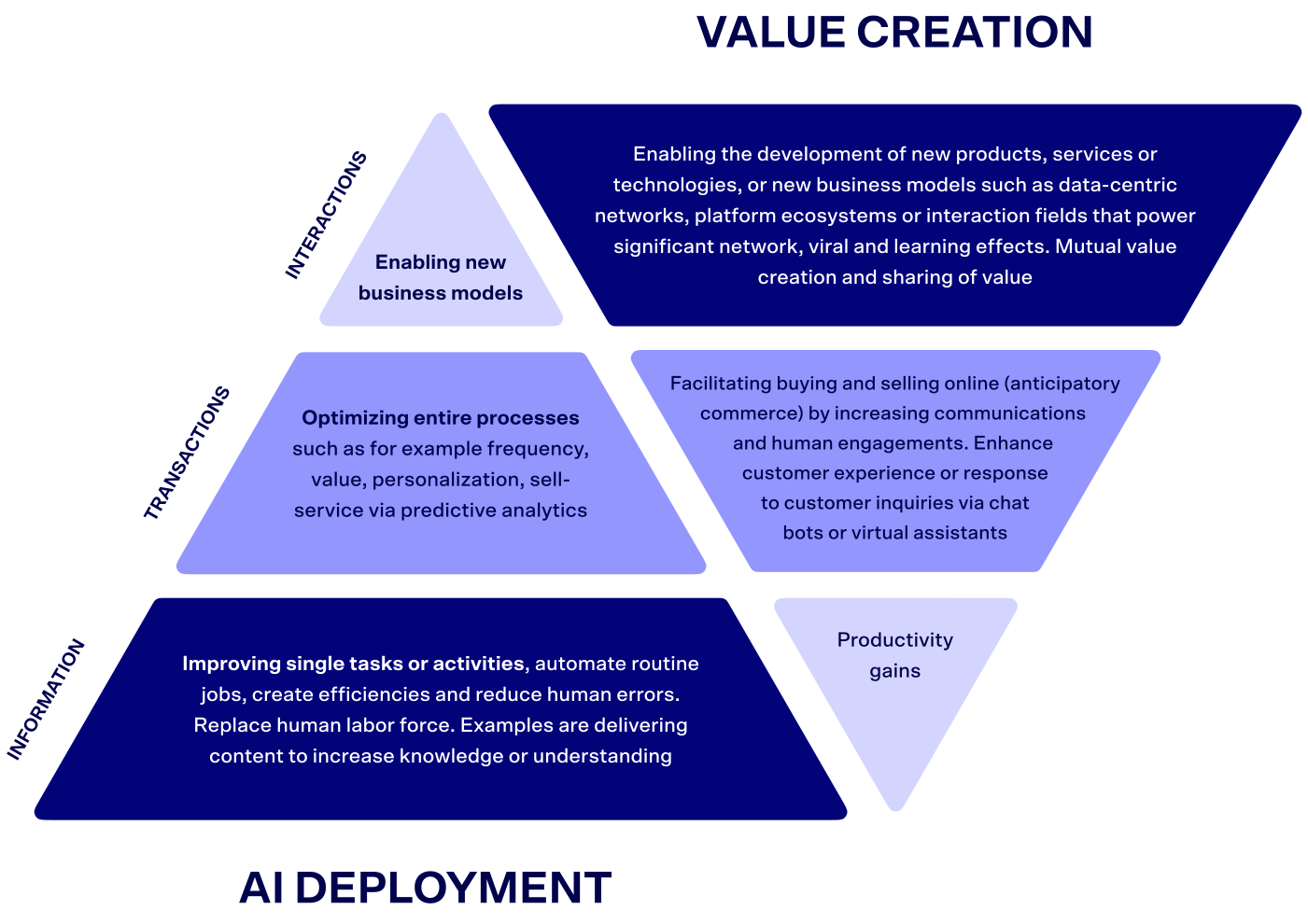
Level 1: Turning Information into Productivity Gains
At the bottom of the model are AI applications that organize and process information to deliver productivity improvements. Studies show that the improvements can range from 20% to 45% depending on the industry, task and technology application. Many AI applications operate at this very level. Basic Gen AI usages are typical of these applications, they augment content and knowledge, for example when I use ChatGPT to summarize an article into a few paragraphs or when I want it to improve them without changing the meaning. I also can use an LLM to explain a topic so that I get a deeper understanding of a topic, or to automate processes that are repetitive, routine, or predictable tasks. Wells Fargo illustrates the potential of AI by employing synthetic data to foster an autonomous innovation process.[4] The institution utilized synthetic users to expedite early-stage innovation, allowing for a deeper understanding of user behavior through the Jobs to Be Done (JTBD) framework. This innovative approach enabled Wells Fargo to carry out extensive interviews and qualitative survey analyzes at scale, efficiently aggregate and prioritize data, and uncover insights into user behaviors in unique situations, such as changes following a natural disaster. The utilization of synthetic users, inherently confidential and operated on a secure, non-internet-connected on-premise Large Language Model (LLM), ensured that sensitive information remained within the confines of Wells Fargo, aligning with the financial industry’s risk-averse nature. The effectiveness of synthetic users was demonstrated through an experiment comparing the survey responses of 8,000 synthetic users against 1,200 real users, divided into five persona groups. The findings revealed that four out of the five groups provided consistent answers, affirming the reliability of synthetic users in mirroring real user responses. These key learnings highlight that synthetic users not only significantly boost productivity by enabling rapid, large-scale testing and analysis of user behavior but also show great promise for the future of autonomous innovation within Wells Fargo. It also shows that integrated into the innovation workflow process, AI can act like a multi-talented assistant that increases efficiency, potentially reduces errors. While it does not replace the work in innovation, it definitely enhances it. At the least, it enables processing of large volumes of information and data quickly and efficiently.
Level 2: Reimagining Processes Through Transactions
The subsequent level pertains to the automation or augmentation of transactions between a company and its customers. This can involve modifying or streamlining the process of buying or selling, engaging in e-commerce or direct-to-consumer strategies, or facilitating monetary transfers through a banking application. L’Oréal’s Beauty Genius serves as an exemplary instance of this concept.[5] It revolutionizes the consumer experience of applying or managing skincare by offering personalized skincare and makeup recommendations. Essentially, Beauty Genius functions as an advanced or AI-enhanced chatbot. It evaluates users’ skin conditions and provides tailored advice. Beauty Genius was developed through training on thousands of images and products, enabling it to offer precise skin analysis and highly customized product suggestions. Users initiate this process by uploading a photo of themselves, which is used to evaluate skin attributes, and by answering detailed questions regarding their skin condition and preferences. This process is highly interactive and engaging, laying the groundwork for accurate skin analysis and the proposal of personalized skincare routines that align with the users’ needs. Furthermore, L’Oréal’s application underscores several key factors for success. AI is integrated in a manner that appears seamless, enhancing users’ daily skincare management without automating or eliminating the user experience. It augments rather than replaces, ensuring users maintain control while benefiting from the synergy of AI and L’Oréal’s expertise in beauty. This approach not only enhances the user experience but also offers L’Oréal advantages such as more targeted product sales, which may increase customer satisfaction and loyalty.
Level 3: Building New Business Models on Interaction
This highest level involves reciprocal communications or data flows between individuals or between individuals and companies. There are much fewer applications of AI at this level today. An example is Amie, a conversational medical AI that is designed to assist in the diagnosis within a doctor-patient relationship.[6] The system helps doctors in the diagnoses, improving its quality, and enabling more diagnoses than are possible today. A doctor for example can see only 10,000 patients in a career, while Amie can potentially “see that many” patients in just a couple of training cycles. Amie stands for Articulate Medical Intelligence Explorer, and while it is still purely experimental, it points toward the real potential of AI in creating significant value for everybody. Researchers at Google developed this AI by feeding it with real-world medical texts, including transcripts of nearly 100,000 real physician-patient dialogues, 65 clinical-written summaries of intensive care unit medical notes, and thousands of medical reasoning questions taken from the United States Medical Licensing Examination. In tests of Amie against real doctors, Aime provided greater diagnostic accuracy and superior performance. Interesting is that the measure of performance included such soft factors as perceived empathy, openness and honesty. Amie performed better than the human counterparts. The value of an AI like Amie can be transformative when considering its expansion possibilities. For example, by seamlessly integrating with EHR systems, Amie could access patient histories, lab results and other relevant data, and even further improve its diagnostic accuracy and personal recommendations based on a patients’ medical history. It could include features aimed at increasing patient engagement and education. Amie could expand into continuous patient monitoring through wearable devise and mobile health apps, providing real-time data to healthcare providers and alerting them to potential health issues before they become serious. Features could be personal health tips, medication reminders, and other interactive tools. Data could be aggregated and analyzed from across millions of patients and identify trends, improve healthcare outcomes, and contribute to medical research, leading potentially to new treatments and deeper understanding of various health conditions. Ultimately, an entire health interaction field could be built on top of these interactions, connecting patients with a variety of health services, such as specialist healthcare providers and doctors provided by institutions or care centers regardless of location, pharmacies for medication delivery, labs for diagnostic tests, and wellness programs.[7] In short, the potential would be to create significant network effects, viral effects and learning effects, by integrating Amie with a wider range of health services, and providing more comprehensive support for both healthcare providers and patients. This can become a wholesale transformation of how healthcare services can be delivered either in-person or through telehealth services. It offers the promise of more personalized, efficient and accessible care, anywhere around the world.
- [1] One of us has discussed these eras in the book: The Interaction Field: The Revolutionary New Way to Create Shared Value for Businesses, Customers and Society, Public Affairs, 2020, p. 17. See also: Cory Doctorow, “What Kind of Bubble,” Medium, Dec 19, 2023.
- [2] Evidence of the concentrated market power of Apple, Alphabet, Amazon, Meta and Microsoft comes from their financials. In 2023, the group together made over $1.6 trillion in revenues, and earned over $327 billion in profits.
- [3] James Manyika and Michael Spence (2023), “The Coming AI Economic Revolution,” Foreign Affairs, November – December.
- [4] Adam Holt (2023), “Innovating with Purpose: Unleashing the Power of Jobs-to-Be-Done and Outcomes-based Innovation,” December 7, Autonomous Innovation Summit.
- [5] https://www.campaignlive.com/article/loreal-showcases-ai-powered-advisor-beauty-genius-ces/1856937
- [6] https://research.google/blog/amie-a-research-ai-system-for-diagnostic-medical-reasoning-and-conversations/?m=1 “rel=nofollow”
- [7] See: Joachimsthaler, Erich (2020), The Interaction Field: The Revolutionary New Way to Create Shared Value for Businesses, Customers and Society, Public Affairs.
The Vivaldi Browser’s Contrasting Stance on AI
In a fascinating turn of market dynamics, another company named Vivaldi—the Vivaldi Browser—offers a compelling counter-narrative to the AI-everywhere frenzy. While we at Vivaldi Group help organizations strategically integrate AI to create new value, the browser company champions a philosophy that deliberately puts human agency before algorithmic assistance. This isn’t a rejection of technology but a strategic choice about its role. The browser’s approach serves as a powerful case study in brand differentiation, demonstrating how a company can build a loyal following not by chasing the latest trend, but by defining a clear, human-centric purpose in an increasingly automated world. It forces a critical question for every leader: Is your AI strategy designed to empower your customers, or to replace their judgment?
A “Humans Over Hype” Philosophy
The Vivaldi Browser’s leadership has taken a firm stand: browsing should be an act of active exploration, not passive consumption. While major competitors like Chrome and Edge are integrating AI assistants to summarize pages and guide users, Vivaldi’s position is that this turns active explorers into passive spectators. Their “Humans Over Hype” philosophy is a direct challenge to the prevailing model that equates value with efficiency. Instead of providing quick answers, their browser is designed as a tool for thinking, comparing, and discovering. This is a brand built on the belief that the user’s curiosity, not an algorithm’s conclusion, is the most valuable asset in the digital experience.
Key Features for Power Users
This philosophy is not just a marketing slogan; it’s embedded in the product itself, which is unapologetically built for “power users.” Founded by the former CEO of Opera, the browser was conceived for a segment of the market that feels constrained by the minimalist, one-size-fits-all approach of mainstream browsers. By focusing on this niche, Vivaldi has cultivated a dedicated user base that values control and capability over simplicity. This strategic focus allows them to build features that might seem excessive to a casual user but are essential for those who live and work in the browser, turning it from a simple content viewer into a comprehensive digital workspace.
Advanced Customization and Tab Management
The browser’s commitment to user agency is most visible in its extreme customization. Users can modify nearly every aspect of the interface, from the placement of tabs to the creation of custom keyboard shortcuts. This is complemented by advanced tab management tools, including tab stacking and “Workspaces,” which allow users to group tabs for different projects. In a world of standardized user experiences, Vivaldi hands the design controls back to the user. This isn’t just about aesthetics; it’s about enabling individuals to build a tool that perfectly matches their unique workflow, transforming the browser into a personalized productivity engine.
Integrated Productivity Tools
Further extending its role as a central work hub, Vivaldi integrates a suite of productivity tools directly into the browser, including its own email client, calendar, RSS feed reader, and note-taking app. This creates a self-contained ecosystem that reduces the need for users to switch between multiple applications. While some find these additions unnecessary, for its target audience, this integration is a powerful value proposition. It’s a strategic move to build a “stickier” platform by delivering a more holistic and efficient workflow, creating a moat around the user experience that goes beyond simple web browsing.
Potential Downsides and User Concerns
No strategic choice comes without trade-offs, and Vivaldi’s feature-rich approach presents several challenges. For a brand to be authentic, it must acknowledge its limitations, and understanding these concerns provides a more complete picture of Vivaldi’s market position. These issues highlight the delicate balance between delivering powerful functionality and ensuring broad accessibility and trust, a core tension in modern product development. Acknowledging these points is essential for any organization looking to build a similarly focused, high-utility product.
Performance and Resource Usage
The browser’s extensive feature set can come at a cost. Some users, particularly those on older or less powerful hardware, report that Vivaldi can be resource-intensive, leading to slower startup times and higher memory usage compared to its more streamlined competitors. This performance trade-off is a direct consequence of its “power user” focus. The brand has implicitly chosen to prioritize deep functionality over lightweight speed, a decision that sharpens its appeal to its core audience but may limit its adoption by the broader market that prioritizes speed above all else.
Partially Closed-Source UI
A significant point of contention within the tech community is that Vivaldi is not fully open-source. While it’s built on the open-source Chromium engine (the same as Google Chrome), its user interface code remains proprietary. For a segment of users who prioritize transparency and community-led security audits, this lack of complete openness can be a source of mistrust. This highlights a fundamental strategic decision: balancing the protection of proprietary innovation against the trust-building benefits of a fully open-source model, a challenge many tech companies face.
Syncing Issues
The complexity of Vivaldi’s feature set also creates execution challenges. A minority of users have reported occasional issues with the browser’s sync functionality, which is designed to keep settings, bookmarks, and tabs consistent across different devices. While not a widespread problem, it underscores the operational difficulty of maintaining a seamless experience on a complex, cross-platform product. It serves as a reminder that even the most compelling brand and innovation strategy relies on flawless technical execution to deliver on its promise.
Commitment to Privacy and Security
In an era where personal data is the primary fuel for AI models, Vivaldi’s strongest differentiator is its unwavering commitment to privacy. The company has a strict no-tracking policy, does not sell user data, and uses end-to-end encryption for synced data. Crucially, user data is stored on servers in Iceland, a country with some of the world’s most robust privacy laws. This stance is not just a feature; it is the cornerstone of their brand identity. By positioning itself as a guardian of user privacy, Vivaldi builds deep trust and offers a clear alternative to the data-hungry ecosystems of its largest competitors, turning a principled stand into a powerful competitive advantage.
Frequently Asked Questions
How is this AI boom different from the dot-com bubble? The key difference is the starting point. The dot-com era was about building the digital world from the ground up and getting consumers to join. This AI era is about making sense of the massive, hyperconnected world we’ve already built. Unlike previous tech shifts that were driven by consumer adoption, this one is being championed by the C-suite, which means companies are actively pulling the technology into their operations, not just waiting for customers to push it on them.
Your AI Value Model has three levels. What’s the most important takeaway? The main idea is that AI value creation is a journey of increasing sophistication. Many companies get stuck at the first level, using AI for simple productivity gains. While that’s a great start, the real, game-changing value is created at the highest level. This is where you use AI to build new, interactive business models that create network effects, locking in your market position and creating a sustainable competitive advantage.
An executive in the article claimed big companies will win because they have the data. Is it really that simple? Having vast amounts of data is a significant head start, but it’s not a guaranteed win. Data is just the fuel; you still need a powerful engine and a map to get where you’re going. The engine is your AI capability, and the map is your strategy. The most successful companies won’t just be the ones with the most data, but the ones who use it most creatively to reimagine customer transactions and build entirely new interaction models.
What’s a realistic first step for a company looking to get serious about AI? Don’t feel pressured to build a revolutionary new business model from day one. The most effective and realistic starting point is focusing on Level 1 of our model: productivity. Look for internal processes where AI can automate routine work, analyze information faster, or augment your team’s capabilities. These initial wins deliver clear ROI and build the organizational muscle and confidence needed for more ambitious, customer-facing AI initiatives down the road.
Why did you spend so much time discussing the Vivaldi Browser if you’re not affiliated? First and foremost, we wanted to clear up any confusion—we are two completely separate companies. But their story offers a powerful lesson in strategy. In a world rushing to adopt AI for everything, they’ve built a strong brand by taking a deliberate, human-centric stance against it. It’s a perfect example of how a clear purpose and a deep understanding of your target audience can be more powerful than simply chasing the latest technological trend.
Key Takeaways
- Data, not just technology, is the new competitive moat: Unlike past tech booms that built new infrastructure, the AI era rewards companies that already possess deep, proprietary data sets, giving data-rich incumbents a significant head start.
- Evolve AI’s role from assistant to ecosystem builder: The most transformative AI strategies move beyond simple task automation. The path to real value progresses from enhancing productivity to redesigning customer transactions and ultimately creating new, interactive business models.
- Your AI stance is a core brand statement: The choice to integrate AI is no longer just a technical decision; it’s a defining part of your brand’s philosophy. Whether you embrace AI for efficiency or champion human-centric alternatives, your position shapes your relationship with customers.
Related Articles
- New Business Model Design Consulting Services
- AI Business Model Innovation Strategy Consulting
- Business Model Innovation Consulting Services
- Vivaldi – AI Report 2025