
Your biggest competitor might be your own brand down the hall. When brands in a portfolio lack clear roles, they inevitably drift toward the same promises, chasing the same customers and cannibalizing each other’s market share. This internal friction is a quiet killer of growth, driving up costs while confusing the very buyers you aim to attract. The old model of simply adding more brands to capture more of the market is broken. A disciplined brand portfolio strategy is the antidote. It transforms a chaotic collection of competing assets into a synergistic system designed to cover the market, create clarity, and build cumulative value.
The rules of growth have changed. In an era defined by shifting demand, AI-driven disruption, and relentless competition, a winning brand portfolio strategy is no longer a back-office clean-up exercise. It is a front-end strategic lever that drives business growth, unlocks innovation, and creates competitive insulation. Vivaldi Group has seen that companies with multiple brands outperform peers when they orchestrate clear roles, design powerful relationships, and build a portfolio that maps to evolving customer needs and use cases. If you wait to “fix” the portfolio later, you risk cannibalization, wasted investment, and a confusing customer experience that erodes value faster than you can rebuild it. Below, Vivaldi Group lays out a pragmatic, visionary approach, rooted in market realities and brand leadership, to help most companies design, evolve, and manage a brand portfolio that delivers profitable growth now and long into the future.
Why Brand Portfolio Strategy Is A Front-End Growth Engine
For Vivaldi Group , the purpose of brand portfolio strategy is simple: to accelerate growth by making the right brand do the right job. This means setting portfolio roles so that each brand creates clarity, synergy, and leverage rather than overlap and confusion. When all the brands serve distinct needs and emotional territories, target audience understand where each brand fits, decision friction drops, and the company can capture more value across price points, regions, and usage occasions. If portfolio strategy is not managed as a front-end lever, brands drift toward the same brand promises, cannibalizing one another and diluting equity. Vivaldi Group works with leaders to use portfolio strategy to:
- Expand into new segments and geographies without undermining the primary brand.
- Create brand platforms that welcome innovation.
- Spread risk across categories and mindsets.
- Increase pricing power and market share by offering different brands tailored to different consumers and market segments.

Defining A Brand Portfolio That Serves The Business
A brand portfolio is the collection of brand assets masterbrands, sub brands, endorsed brands, and stand-alone brands owned by a company. Vivaldi Group defines a modern brand portfolio as an operating system for growth: one that aligns to strong brands, business goals, customer segments, and category dynamics. The best portfolios are explicit about how brands complement each other within the portfolio and how the parent company supplies shared capabilities, scale, and governance. In our work at Vivaldi Group , we ensure the brand portfolio:
- Avoids redundancy while creating multiple access points for new customers.
- Enables expansion into different market segments and price tiers.
- Minimizes internal conflict so brand teams focus on creating value, not defending turf.
- Uses clear brand names and relationships to tell customers what to expect.
Distinguishing Between a Brand and an Offering
Many leaders mistake a long list of products for a strong portfolio of brands. This is a critical error. An offering—a specific product, service, or feature—creates a functional, often transactional, connection with a customer. A brand, however, builds an emotional one. It’s the promise, the reputation, and the set of expectations that live in the customer’s mind. While an offering answers the question “What do you sell?”, a brand answers “Why should I care?” Without this clarity, you aren’t managing a portfolio of strategic assets; you’re just managing a catalog.
This distinction is the bedrock of effective portfolio management. When offerings are treated as brands, they start to overlap and compete for the same mental real estate, leading to the cannibalization and diluted equity we see so often. The strategic question isn’t just “What should we launch next?” but “Does this new value proposition require its own brand to succeed, or can it strengthen an existing one?” Answering this correctly is fundamental to designing a brand and innovation strategy that assigns clear roles, ensuring the portfolio as a whole captures more market value rather than fighting itself for scraps.
Align Portfolio Strategy With Enterprise Objectives
Brand decisions must serve the enterprise. Vivaldi Group ensures the portfolio strategy aligns to strategic imperatives:
- Growth: Introduce products and new brands to reach different market segments faster.
- Efficiency: Consolidate other brands where overlap exists; share content, data, and platforms.
- Innovation: Build brand platforms that can stretch credibly into adjacent spaces.
- Resilience: Balance the portfolio to manage exposure across cycles and categories.
Leadership alignment matters. Vivaldi Group often convenes cross-functional teams to lock in the role each brand plays, the markets it serves, and how success will be measured across brands.
Brand Positioning Across The Portfolio To Avoid Cannibalization
When all the brands chase the same audience with similar promises, cannibalization is inevitable. Vivaldi Group helps clients establish positioning clarity across the portfolio based on distinct need states, pricing ladders, and channels. With only one precise use of the term here: brand positioning is set to ensure each brand leads somewhere specific and valuable for the business. To sharpen roles, Vivaldi Group recommends:
- Map propositions to emotions and occasions.
- Calibrate pricing, performance, and aesthetic appeal by brand.
- Stagger distribution and regional emphasis to reduce clashes within the portfolio.
- Coordinate communications to clarify choice and create pull for each brand.
Mapping Demand Landscapes And Customer Segments
A static segmentation misses the way people buy across occasions. Vivaldi Group builds dynamic demand landscapes that blend qualitative insight, social signals, and transaction patterns. We map functional and emotional drivers, unspoken tensions, and emerging behaviors to reveal where brands should play and how. This is how brands discover white space and new customers, and where a new brand (or a new extension of an existing brand) can create outsized value. Vivaldi’s clients use this work as an operating compass for portfolio decisions quarter by quarter.
Brand Architecture Choices: Branded House, House Of Brands, And Hybrids
Brand architecture defines how brands are named, organized, and related. Vivaldi Group guides leaders through the spectrum:
- Branded house: One parent brand leads across offerings, signaling a cohesive experience. A branded house can be powerful for speed and trust.
- House of brands: Distinct brands stand independently to target different audiences or categories, each free to define unique propositions within the portfolio.
- Hybrids: Endorsed brands and sub brands combine corporate equity with category-specific relevance.
A single brand approach increases efficiency but can limit flexibility; a house of brands increases focus but may raise marketing costs. Vivaldi Group designs architecture to your risk profile and growth plan so brands are operated differently where it matters and harmonized where it pays off most.
The Branded House: Pros and Cons
The branded house model centralizes power in a single master brand, like Google or FedEx. This approach is powerful for building market trust and moving with speed. Every new product or service launch benefits from the instant recognition and equity of the parent brand, creating a cohesive customer experience and streamlining marketing efforts. It sends a clear, unified signal to the market, which can be a significant advantage. However, this unity is also its primary vulnerability. The model can limit flexibility when trying to serve diverse market segments with conflicting needs. More critically, the brand’s reputation is concentrated; a failure in one area can create a negative halo effect that damages the entire portfolio, making risk management a central concern for any company pursuing this path.
The House of Brands: Pros and Cons
In contrast, a house of brands strategy, famously used by companies like P&G, allows distinct brands to stand on their own. Each brand is free to conquer a specific niche, targeting unique audiences with tailored value propositions. This structure provides incredible focus and insulates the parent company from risks associated with any single brand’s performance. It’s a powerful way to dominate multiple categories simultaneously. The trade-off is complexity and cost. Building and maintaining separate brands requires significant investment in marketing and management, forgoing the efficiencies of a master brand. Without a strong central strategy, these brands can end up competing against each other for resources and market share, demanding a sophisticated approach to business strategy and transformation.
Choosing Your Architecture: Key Strategic Questions
The right architecture is not a matter of trend but of strategic fit. The decision hinges on your enterprise goals, risk tolerance, and growth ambitions. A single brand approach drives efficiency but can limit market reach, while a house of brands offers focus at a higher operational cost. Before committing, leaders must ask critical questions: Does our growth plan require entering diverse markets that a single brand cannot credibly stretch to cover? How much risk is the enterprise willing to consolidate under one name? Do we have the financial and operational capacity to build and sustain multiple brands? Answering these questions requires a holistic view of the business, which is why we help clients design an architecture that serves their unique vision for growth and innovation, ensuring the entire brand system is built for long-term value creation.
Brand Portfolio Roles: From Flagship Brand To Flanker Brand And Cash Cow Brand
Clear roles reduce conflict and improve resource allocation. Vivaldi Group commonly uses these roles:
- Flagship brand: The lead brand that sets the tone for the company’s brand and category leadership.
- Flanker brand: A brand designed to compete in adjacent price tiers or benefits to protect the flagship.
- Flanker brands: Multiple flankers can bracket the market to limit competitor entry.
- Cash cow brand: A mature, efficient brand that maintains contribution and helps maintain cash flow.
- Cash cow brands: Sometimes plural when legacy lines still deliver profit without heavy investment.
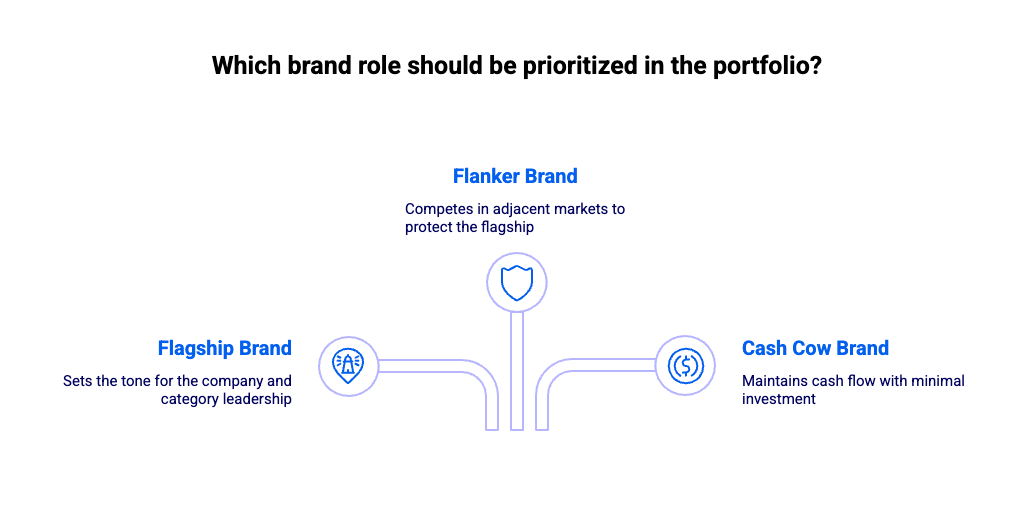 Vivaldi Group ensures roles are measured, resourced, and evolved as market dynamics change.
The Prestige Brand: Setting the Aspirational Ceiling
The prestige brand is the portfolio’s North Star. It functions as the aspirational ceiling, defining the upper limits of quality, innovation, and experience for the entire company. This brand isn’t just about serving a high-end niche; its primary role is to create a powerful halo effect that elevates the perception of every other brand in the portfolio. By establishing a clear benchmark for excellence, it implicitly promises a standard of quality that trickles down to the entry-level and flanker offerings. This strategic positioning allows the entire portfolio to command greater perceived value, giving other brands in the family more credibility and pricing power than they could achieve on their own.
The Entry-Level Brand: Opening the Door to New Customers
Think of the entry-level brand as the portfolio’s welcome mat. Its job is to lower the barrier to entry and serve as the primary customer acquisition engine, inviting a broader audience into your brand ecosystem. This isn’t about being the “cheap” option; it’s a strategic play to capture market share and introduce new segments to your company’s core promise. The entry-level brand provides the first taste of your quality and values, acting as an on-ramp for customers who may later trade up to more premium products. By creating an accessible starting point, you build a wider, more diverse customer base and establish a long-term pipeline for growth across the entire portfolio.
Building A Strong Brand Portfolio For Profitable Growth
A strong brand portfolio makes it easier to reach high-value audiences, enter adjacent categories, and defend share. Vivaldi Group connects portfolio choices to profitable growth by calibrating brand investments to role, potential, and risk. We build decision rules for when to launch a new brand versus stretching an existing brand, how to use the parent brand for leverage, and when to retire smaller brands to reduce complexity. This is how cash cow brands help brands grow faster without losing coherence.
Brand Portfolio Examples: Coca Cola, LVMH, And Virtually Every Industry
Brand portfolio examples make strategy concrete. Vivaldi Group often points to systems across virtually every industry:
- Coca Cola combines iconic global equities with local relevance to compete in many market segments.
- LVMH orchestrates luxury maisons with autonomy and shared platforms.
- Technology leaders deploy endorsed or sub brands to balance trust with differentiation.
These brand portfolio examples show how clarity and discipline help brands pull away from rivals even when the category is crowded.
How A Parent Brand And Parent Company Create Leverage Within The Portfolio
The parent brand signals trust, standards, and shared meaning; the parent company provides shared capabilities data, platforms, supply, and go-to-market muscle. Vivaldi Group designs the right level of visibility for the parent brand and parent company to create leverage without stifling creativity within the portfolio. Some categories benefit from a lighter touch to avoid confusing different brands; others require a stronger endorsement to speed adoption and reduce risk.
New Brands Vs. Extending An Existing Brand Under A Brand Umbrella
When should you launch new brands instead of stretching an existing brand? Vivaldi Group uses three tests:
- Relevance: Can the existing brand credibly carry the new meaning?
- Risk: Will the move endanger core equity?
- Return: Will a brand umbrella or endorsement improve efficiency and speed?
If the answer is “no” to relevance or “yes” to material risk, a new brand is favored. If the offering strengthens the original brand and the brand umbrella adds trust, extension wins. Vivaldi Group sets rules so teams know when to build or borrow.
Flanker Brands, Fighter Brand, And Entry Level Brands: Winning Access Across Different Market Segments
Price architecture is a portfolio superpower. Vivaldi Group deploys flanker brands to protect premium positions, a fighter brand to blunt low-cost attackers, and entry level brands to welcome value-minded buyers without diluting the flagship. The goal is to serve different market segments with clear promises rather than pulling every customer to the same brand. When well executed, these moves also attract potential customers who would never have considered the portfolio otherwise.
Managing Brand Names And Sub Brands To Target Different Consumers And Potential Customers
Naming and sub brands matter. Vivaldi Group aligns brand names, descriptors, and sub brands to signal benefits quickly to different consumers. Clarity attracts potential customers and helps existing buyers trade up or across. We standardize rules for how new names appear, how they relate to the parent brand, and how they evolve within the portfolio as needs change.
Pricing Architecture: Lower Price Points, High End Prestige Brands, And Affordable Products
Great portfolios cover the ladder from lower price points to high end prestige brands with discipline. Vivaldi uses pricing and benefit tiers to position affordable products separately from premium lines. This avoids confusing the same brand with mixed signals and ensures customers understand what each brand stands for. With the right structure, brands can move buyers upward over time while keeping the entry level brand healthy and credible.
Channels And Geographies: How Separate Brands And One Brand Systems Are Operated Differently
Different channels and regions often require separate brands for local fit, while a one brand system speeds scale in unified categories. Vivaldi helps leaders choose where brands should be operated differently, how to adapt messaging, and when to consolidate for efficiency. We design governance so teams know when regional tweaks help and when they threaten coherence.
Measuring Brand Performance And Market Share To Maintain Cash Flow
Measurement is the backbone of portfolio management. Vivaldi blends classic KPIs – brand performance, preference, pricing power with market share tracking and brand contribution to cash flow. We add leading indicators from social and search to spot shifts early. The result is a shared view of which brands deserve investment now, which to harvest, and where a targeted bet could unlock the next step-change.
Market Research, Social Listening, And The Company’s Market Share: How To Maintain Brand Portfolios
Vivaldi modernizes market research by integrating cultural signals, retail data, and first-party insight. We track the company’s market share and shifts in consideration within the portfolio as new entrants appear. To maintain brand portfolios at peak effectiveness, we run regular portfolio health checks, test role clarity with real buyers, and pressure-test whether a brand still earns its place or should be merged, retired, or reinvented.
From Flagship Beverage And Food Products To Smaller Brands: Orchestrating Across Product Category
Portfolios live in the real world where categories blur. Vivaldi helps clients orchestrate across product category lines say, from a flagship beverage into adjacent food products without undermining the equity of smaller brands. We define which categories the flagship should lead, where endorsed brands create speed, and where new brands are the right choice to seed future growth within the portfolio.
Loyalty And Equity: Building A Loyal Customer Base And Loyal Customers For Strong Brands
High-performing portfolios turn trial into loyalty. Vivaldi designs journeys that build a loyal customer base for flagship, entry level brand, and supporting brands, using role-specific content, service, and communities. We create bridges so loyal customers of one brand can discover other brands in the family without confusion or friction. This is how portfolios compound equity across time.
Avoid Confusion: Same Brand Vs Different Brands, And When To Introduce Products Under The Primary Brand
Not every innovation belongs under the same brand. Vivaldi’s rules for when to introduce products under the primary brand or create different brands consider risk, clarity, and runway for future growth. We put the customer first: if a new meaning stresses the core promise, build a new brand; if it reinforces it, extend. These decisions protect equity while capturing opportunity.
Governance To Ensure Brand Portfolios Work Across Brands And Brand Strategy
Without governance, portfolios drift. Vivaldi sets up councils and rituals to align brand portfolios with enterprise goals and brand strategy. We define role charters, performance guardrails, and shared assets so brands complement not compete with each other. Clear decision rights and cadence allow teams to move fast without creating noise across brands.
Coca Cola Company As A Case: How A Beverage Company Uses Brand Portfolio Strategy
Consider the Coca Cola Company. As a beverage company with global scale, Coca Cola uses a disciplined brand portfolio strategy to operate iconic lines and niche offerings side by side. Vivaldi points to how Coca Cola calibrates equity across geographies, introduces a new brand when needed, and streamlines where overlap appears. The Coca Cola Company blends global consistency with local nuance, proving that portfolio choices are as much about governance as they are about creativity.
The Economics Of Portfolio Design: When Fewer, Bigger Brands Win
Not every category benefits from an extensive portfolio. Vivaldi Group often finds that fewer, bigger brands outperform an overly complex system. We run contribution analyses to decide when to merge smaller brands, when to protect an entry level brand that feeds the funnel, and when to retire offerings that no longer serve the strategy. The aim is to maximize value creation, not brand count.
The Power of Simplification: Lessons from Apple
The impulse to add more brands to capture more market share often backfires, creating a portfolio that is complex, costly, and confusing to customers. The most powerful strategic moves are often acts of reduction, not addition. When Steve Jobs returned to Apple in 1997, he famously cut 70% of the company’s products. This wasn’t just about trimming costs; it was a deliberate strategy to restore clarity and focus. By simplifying the lineup, Apple made it radically easier for customers to understand its value and for the company to channel its innovation into the products that truly mattered. A bloated portfolio doesn’t just create market confusion; it dilutes brand equity and forces internal teams to compete for resources, ultimately hurting the customer experience and eroding the bottom line.
Focusing on High-Value Assets: The 80/20 Rule in Portfolios
Not all brands are created equal, and a successful portfolio strategy acknowledges this reality. The Pareto principle often applies: a small number of brands typically generate the vast majority of the value. Our own analysis at Vivaldi Group confirms this; we frequently find that about one-third of a company’s brands drive over 70% of its enterprise value. The strategic imperative is clear: identify your high-performers and invest in them disproportionately. A strong brand portfolio, anchored by these high-value assets, becomes a powerful platform to reach premium audiences, expand into adjacent categories, and build a defensible market position. This intense focus ensures that resources are channeled toward profitable growth, not just maintaining complexity for its own sake.
Orchestrating Ecosystems Of Meaning And Shared Value
The best portfolios act like ecosystems brands that work together to create meaning, behavior, and shared value. Vivaldi Group helps clients build connective tissue across brands: loyalty programs, data platforms, and service layers that make the whole greater than the sum of its parts. In markets where AI reshapes discovery and choice, ecosystem thinking ensures your brands show up together, reinforce one another, and capture demand you would otherwise miss.
Coca Cola And Peer Brand Portfolio Examples: Learning Across Categories
Looking again at Coca Cola and peer systems, Vivaldi Group surfaces transferable lessons. Coca Cola keeps its flagship brand focused while experimenting with new brands and flavors to attract new customers. It uses endorsed or stand-alone approaches depending on risk. These brand portfolio examples highlight consistent truths: clarity beats clutter, roles matter, and customer understanding is the ultimate advantage.
Decision Rules: Launch A New Brand Or Extend The Original Brand?
Executives ask Vivaldi Group for clear decision rules:
- Launch a new brand when the new promise conflicts with the original brand or targets distinct customer segments.
- Extend the original brand when the promise strengthens the core and the parent brand adds trust.
- Use endorsement when you need both speed and separation.
These rules protect equity while accelerating growth within the portfolio.
Architecture In Practice: Branded House Versus House Of Brands Trade-Offs
A branded house can move fast, compounding awareness. A house of brands can win with tailored propositions and pricing flexibility. Vivaldi Group often uses hybrids to mix benefits, sub brands for category relevance, endorsed marks for trust. We document when to lean into the company’s brand and when to let other brands lead, ensuring teams apply architecture consistently across markets.
Advanced Role Design: Flanker Brand Strategies Across Channels
Flankers are powerful in retail and digital. Vivaldi Group builds flanker brand plays to recapture shoppers trading down or to block competitors in marketplaces. Across channels, flanker brands can test innovations, partner with retailers, or target regional preferences without risking the flagship brand. This disciplined approach lets brands cover more ground with less internal conflict.
Cultural Relevance: When High End Prestige Brands Shape Aspiration
In categories driven by identity, high end prestige brands anchor aspiration. Vivaldi Group ensures these brands stay sharp on meaning, while adjacent offerings handle volume. We calibrate roles so status symbol cues don’t leak into everyday lines, and we set pricing and distribution rules so each brand keeps its lane and audience.
Practical Mechanics: Maintaining Coherence Within The Portfolio
Coherence takes work. Vivaldi Group implements:
- Naming matrices to manage brand names consistently.
- Clear rules for sub brands and descriptors so customers recognize value.
- Review cycles to retire or refresh as needed.
These mechanics keep brands focused while allowing experimentation where it creates advantage.
Establishing Naming Conventions and Visual Systems
Your naming system is the grammar of your portfolio; it teaches customers how to interact with your brands. When done right, it creates an intuitive logic that guides choice. At Vivaldi Group, we focus on aligning brand names, descriptors, and sub-brands to signal benefits instantly. This clarity doesn’t just attract new customers; it creates pathways for existing buyers to trade up or across the portfolio with minimal friction. We help clients build standardized rules for how new names are introduced, how they relate to the parent brand, and how they can evolve as the business grows. This isn’t about rigid control—it’s about creating a coherent language that makes the value of each brand obvious.
Integrating Brands from Mergers and Acquisitions
An acquisition isn’t the end of a transaction; it’s the beginning of a strategic integration. When a new brand enters the portfolio, the immediate question is how it will create value within the existing system. Should it be absorbed into the master brand, operate as an endorsed entity, or stand alone to protect its unique equity? The answer depends on the strength of the acquired brand, the overlap of its customer base, and its alignment with your long-term growth ambitions. A valuable brand is more than just an available asset; it’s a source of new capabilities, market access, and customer relationships. Deciding its role is a critical act of strategic portfolio management that dictates future returns.
Category Storylines: Beverage, Food Products, And Beyond
Portfolios evolve with category stories. Vivaldi helps beverage and food products players move from sugar-based lines to wellness platforms, from single brand scale to differentiated families. We use architecture and roles to guide transformation while protecting the flagship beverage and core equities audiences still love. Pricing Ladders: Entry Level Brands That Build The Franchise Entry level brands matter. Vivaldi designs entry level brand programs that bring first-time buyers into the family and graduate them to premium lines. We tie incentives to lifetime value, not short-term volume, so teams invest where the portfolio grows strongest over time.
AI-Era Discovery: Why Clarity Across Brands Matters More Now
In AI-powered search and shopping, ambiguity kills. Vivaldi tunes brand signals names, roles, claims, so algorithms and customers understand which brand addresses which problem. Clear roles increase visibility and conversion when buyers ask for solutions, not logos. This is how brands protect and grow share when the ground keeps moving.
Risks To Watch: When Brand Portfolios Drift
Left alone, portfolios drift toward bloat. Vivaldi flags warning signs:
- Overlapping propositions and promotions confuse customers.
- Teams defend turf instead of building value across brands.
- The parent brand gets stretched thin, losing meaning.
We install governance and metrics so leaders course-correct early.
Common Causes of Portfolio Bloat
Portfolio bloat isn’t about the number of brands you own; it’s about the amount of friction they create. It happens when brands within the portfolio stop creating distinct value and start generating internal competition and external confusion. This drift is often gradual—a series of small, seemingly logical decisions that, over time, lead to a system where brands overlap, resources are spread thin, and the portfolio as a whole becomes less than the sum of its parts. The most common culprits are not failures of individual brand managers but failures of the portfolio’s strategic architecture. Below are the three primary drivers of portfolio bloat that we see eroding value in large organizations.
Brand Cannibalization: Competing Against Yourself
When your own brands are fighting for the same customer, with the same message, in the same channel, you are paying to compete against yourself. This is brand cannibalization, and as we often see at Vivaldi Group, it becomes inevitable when brands chase the same audience with similar promises. Instead of capturing new market segments, the brands simply steal share from one another, driving up marketing costs and depressing margins. This internal rivalry extends beyond marketing campaigns; it creates conflict in sales channels, confusion for retail partners, and a zero-sum mindset among internal teams who should be collaborating to grow the entire enterprise, not just their slice of it.
Customer Confusion: When More is Less
From the outside, a bloated portfolio looks like a wall of noise. When customers are confronted with multiple brands from the same company that seem to do the same thing, they don’t spend more time trying to figure it out—they tune out. This phenomenon, often called the paradox of choice, creates decision fatigue and can lead customers to abandon your ecosystem altogether for a competitor with a clearer, simpler promise. Having too many overlapping brands makes it difficult for a company to define its target audiences with any precision, ultimately weakening the equity of every brand involved and making it nearly impossible to build a truly loyal customer base for any of them.
Underperforming Assets: Draining Resources and Focus
Every portfolio has brands that are no longer pulling their weight. These underperforming assets are more than just a line item on a balance sheet; they are a strategic drain. They consume disproportionate management attention, tie up capital, and complicate the supply chain, all while delivering minimal returns. Each brand in a portfolio must serve a clear business goal, whether it’s driving profit, entering a new market, or defending against a competitor. When a brand loses its purpose, it becomes a distraction, pulling vital resources and focus away from the flagship brands and high-growth opportunities that should be getting the investment.
Warning Signs: When to Re-evaluate Your Portfolio
Portfolios rarely fail overnight. They drift. Without active governance, they accumulate complexity and lose clarity, slowly eroding value until a crisis forces a reaction. At Vivaldi, we help leaders spot the early warning signs before the drift becomes a drain on the entire business. The first signal is often internal: teams begin defending their turf instead of building value across the portfolio. Promotions for different brands start to look identical, and the strategic rationale for why one brand exists versus another becomes fuzzy even to the people managing them. This internal friction is a clear indicator that the portfolio’s logic has broken down and a strategic reset is needed.
You should re-evaluate your portfolio if you recognize these red flags. Are your brand teams bidding against each other for the same search keywords? Do your retail partners express confusion about which brand to prioritize for promotions? Is your innovation pipeline launching products that could fit under multiple existing brands? Are your customer satisfaction scores declining due to perceived product overlap? These are not isolated tactical issues; they are symptoms of a portfolio that is no longer aligned with your business strategy or the realities of the market. Addressing them requires moving beyond brand-level fixes to a holistic re-examination of the roles, relationships, and rules that govern your entire brand ecosystem.
A Strategic Framework for Portfolio Evaluation
A portfolio review shouldn’t feel like a historical audit. It’s a forward-looking strategic exercise designed to align your brand assets with where the business is going, not just where it’s been. The goal is to move from a reactive, brand-by-brand assessment to a holistic view of how the entire system creates value. This framework isn’t about creating a static report card; it’s about building a dynamic roadmap for growth. It requires leaders to ask tough questions about which brands are pulling their weight, which are creating drag, and where the next wave of value will come from. By treating evaluation as an ongoing strategic discipline, you can ensure your portfolio is a finely tuned engine for growth, not an accidental collection of assets.
Step 1: Align on Enterprise Goals
Before you can judge a brand’s performance, you need to know what game it’s playing. At Vivaldi, we anchor every portfolio evaluation in the company’s core strategic imperatives. Brand decisions must serve the enterprise, not the other way around. This alignment process forces clarity on the primary job of the portfolio. Is the goal aggressive growth, demanding new brands to capture new segments? Or is it efficiency, requiring consolidation to reduce complexity and share resources? Perhaps the focus is on driving innovation, which means building brand platforms that can stretch into new categories. Or maybe it’s resilience, where the portfolio must be balanced to withstand market cycles. Getting the C-suite aligned on these priorities is the essential first step.
Step 2: Assess Brand Performance and Contribution
Measurement is the backbone of effective portfolio management, but legacy KPIs alone are not enough. A modern assessment moves beyond lagging indicators like market share to include a richer, more predictive set of metrics. We blend classic measures—brand preference, pricing power, and contribution to cash flow—with leading indicators from social listening and search data to spot market shifts before they become trends. This approach provides a complete picture of a brand’s health and its specific contribution to the business. It helps you see not only how a brand performs today but also its potential to create value tomorrow, giving you the insight needed for a truly strategic business transformation.
Sorting Your Assets: Prioritize, Divest, or Re-evaluate
Once you have a clear picture of performance, the next step is to make strategic choices. We often find that fewer, bigger, and better brands outperform an overly complex system. Using a contribution analysis, we help leaders decide which brands to prioritize for investment, which to merge or divest, and which to maintain as stable cash cows. This isn’t just about cutting underperformers; it’s about strategically reallocating resources to the assets with the highest growth potential. The goal is to maximize value creation, not brand count, ensuring every brand in the portfolio has a clear and valuable role to play in the company’s future.
Step 3: Develop the Strategic Game Plan
This is where analysis becomes action. A strong brand portfolio makes it easier to reach high-value audiences, defend market share, and enter new categories with confidence. The final step is to connect your portfolio decisions directly to a plan for profitable growth. This involves calibrating investments based on each brand’s role, its growth potential, and its risk profile. We help clients build clear decision rules for when to launch a new brand versus extending an existing one, how to leverage the parent company for scale, and when to retire a brand to reduce complexity. This strategic game plan ensures your portfolio isn’t just organized—it’s optimized to win.
What Great Looks Like: Vivaldi’s Portfolio Playbook
High-performing portfolios share traits Vivaldi instills:
- Clear architecture and role charters.
- Measurable contribution for each brand.
- Fast, consistent decision rules for launches and retirements.
- Purposeful use of the parent company and parent brand.
- Cross-brand programs that turn buyers into loyal customers.
With these in place, brands create more value together than alone.
Practical Steps To Design Or Reset Your Portfolio With Vivaldi
Vivaldi typically recommends a staged program:
- Diagnose: Audit contribution, overlap, and equity to understand brand performance and role health.
- Design: Set architecture, roles, and naming rules; align operating model and incentives.
- Pilot: Test a new brand launch or an extension decision in a live market.
- Scale: Roll out governance, update content and martech, and train teams across brands.
- Optimize: Revisit market research and metrics quarterly; adjust where signals shift within the portfolio.
Along the way, we align leaders, reduce duplication, and free up investment to fuel the brands that make the biggest difference.
Frequently Referenced Examples And Patterns Vivaldi Sees
- Coca Cola balances a global flagship with local offerings, proving focus and flexibility can coexist.
- Luxury groups separate maisons to protect meaning while sharing back-end power.
- Technology players use sub brands to signal category relevance without building entirely new brands every cycle.
- CPG portfolios use a fighter brand or flanker brand to protect price ladders and shield the flagship brand from discount pressure.
Across these cases, Vivaldi finds the same pattern: clarity of roles and architecture fuels growth.
Mini-Glossary Of Portfolio Terms Vivaldi Uses With Clients
- Parent brand: The corporate or master brand that lends trust and equity to others.
- Branded house: One brand leads across offerings; sub brands and descriptors live under it.
- House of brands: Independent brands stand alone; the parent company stays in the background.
- Endorsed brand: The parent brand adds a “seal” of trust while the product brand leads.
- Flanker brands: Supporting brands designed to defend or expand coverage.
- Cash cow brand: A mature line with high margin and stable, loyal customers.
These shared definitions keep teams aligned and speed decision-making.
Looking Ahead: Portfolio Strategy As Competitive Insulation
As categories converge and distribution fragments, brand portfolios become competitive insulation. Vivaldi Group equips leaders to build portfolios as systems that adapt launching a new brand when necessary, extending an existing brand when wise, and pruning when focus creates more value. With disciplined brand architecture, role clarity, and data-driven governance, brands move together toward a unified vision while winning independently in their lanes. Selected Vivaldi Group Resources
- For how Vivaldi turns insights into growth plays, see Brand Strategy.
- Explore how Vivaldi builds modern growth systems in Innovation Consulting.
- Learn how Vivaldi’s marketing approach connects brand, demand, and data in Marketing Strategy.
Ready to design a portfolio that works as hard as your strategy? Vivaldi can help you set architecture, roles, and governance that turn complexity into competitive advantage. Start a conversation with our team today via Contact.
Frequently Asked Questions
How do I know if my brand portfolio has a problem? The earliest signs are often internal. You might notice your brand teams are competing for the same keywords, budget, or retail space. Externally, you may see marketing campaigns that feel repetitive across your brands or hear from customers who are confused about which product is right for them. If your growth is flat despite launching new offerings, it’s a strong signal that your brands are likely stealing share from each other instead of capturing new ground.
We’re trying to grow, so shouldn’t we just keep adding brands to capture more of the market? That’s a common impulse, but it often backfires by creating a complex and costly system. When you add brands without a clear strategy, they tend to drift toward the same promises and audiences. You end up paying to compete against yourself, which drives up marketing costs and confuses customers. True growth comes from a disciplined portfolio where each brand has a distinct job, allowing you to cover the market synergistically rather than chaotically.
What’s the most critical factor in deciding whether to launch a new brand or extend an existing one? The decision really comes down to credibility and risk. Ask yourself: can your existing brand credibly carry this new promise without confusing its core audience or damaging its reputation? If the new offering serves a completely different need or customer segment, or if it risks diluting what people love about your main brand, then a new brand is almost always the smarter, safer choice for long-term value.
My brand teams seem to be fighting for the same customers. How does portfolio strategy fix that? This is a classic symptom of a portfolio that lacks clear roles. It’s not a team problem; it’s a system problem. A strong brand portfolio strategy solves this by giving each brand its own distinct lane to win in—a specific audience, need state, or price point. When every brand has a clear charter and knows its unique job, internal teams can stop competing with each other and focus their energy on winning against the actual competition.
This all makes sense, but where do we even begin to fix a portfolio that has grown messy over time? The most effective starting point isn’t to audit every single brand right away. Instead, begin by aligning your leadership team on a single question: what is the primary goal of our portfolio right now? Is it to drive aggressive growth, improve efficiency, build resilience, or fuel innovation? Answering that question provides the strategic compass you need to make all subsequent decisions about which brands to invest in, which to consolidate, and which to retire.
Key Takeaways
- Treat Your Portfolio as a Strategic Growth Engine, Not a Catalog: A disciplined brand portfolio strategy transforms a chaotic collection of assets into a synergistic system. It’s a front-end lever for growth that clarifies market position and prevents internal brands from competing against each other.
- Assign Every Brand a Specific Job to Maximize Market Coverage: To avoid cannibalization, each brand must have a distinct role—whether it’s a flagship, flanker, or entry-level offering. This clarity ensures your portfolio captures more value across different customer segments, price points, and occasions.
- Use Architecture and Governance to Make Decisions with Confidence: The right structure (like a Branded House or House of Brands) and clear rules for when to launch, extend, or retire a brand are essential. This framework turns your strategy into a repeatable process for building long-term value.