
Your brand is a strategic asset. So is your intellectual property. But the most overlooked and mismanaged asset in most organizations is the collective discretionary energy of its people. We measure its symptoms—turnover, productivity dips, and missed targets—but consistently fail to manage its source. True value creation begins when you treat engagement not as a soft HR metric, but as a core component of your growth engine. To do this, you must understand its architecture. The answer to what are the three key elements of employee engagement is not a simple list; it’s a strategic framework for activating the human capital that will ultimately define your market leadership and separate you from the competition.
Article by Matthias Tröbinger, Senior Consultant in our Zurich office. One of the most important, but often overlooked, aspects of building a successful company is an initiative that starts at the ground-level: employee engagement. Employee engagement is defined as a physical, emotional and cognitive state that employees may experience at work (Imperatori & SpringerLink, 2017). It’s a key driver behind high levels of involvement with the organization and increased productivity. Would you be surprised to know that the latest Gallup report shows that only two out of ten employees in Germany and Switzerland are engaged at work? A staggering 66% of the workforce is not engaged and 20% is even disengaged. These are sobering numbers – ones that we see on a daily basis in our project work – but why do these numbers matter?
Engaged employees are satisfied employees
Many studies show that engaged employees tend to feel more confident not only about themselves, but about their work. The Academy of Management Perspectives reports that employee engagement is closely tied to three pivotal well-being aspects: psychological, by way of satisfaction with processes and practices; physical, via employee health; and social, through a high-quality workplace social network. These three pieces complete the puzzle to forming an individual’s satisfaction with (and enthusiasm!) for work. Engaged employees equal satisfied employees. While this is good news for employees, what effect does it have on a company? What happens to the inner workings of a company when they have an engaged workforce?
The Foundational Model of Employee Engagement
For decades, leaders have treated employee engagement like a mechanical problem to be solved with surveys and perks. But engagement isn’t a switch to be flipped; it’s a current of human energy that can either power an organization forward or dissipate into apathy. To channel it, we first have to understand its sources. The foundational framework, first defined by psychologist William Kahn, identifies the three psychological conditions that must be met for employees to invest their full selves—not just their time—into their work. This isn’t a checklist; it’s a blueprint for creating an environment where people can and want to do their best work.
Cognitive Engagement: The “Why”
This is about strategic clarity. It’s the direct line of sight an employee has from their daily tasks to the company’s north star. When people understand precisely how their work creates value and moves the business forward, their effort stops being transactional and becomes strategic. This isn’t about cascading down objectives; it’s about building a shared understanding of the mission. Without this intellectual buy-in, even the most talented teams work in silos, and their collective energy becomes fragmented rather than focused.
Emotional Engagement: The “Feel”
This is the brand’s internal gravity. Emotional engagement is the force that pulls people toward the company’s purpose, creating a powerful sense of belonging and pride. It’s the difference between wearing the company logo on a shirt and carrying its mission in your heart. This connection is what fuels resilience during tough quarters and inspires the kind of authentic advocacy that marketing budgets can’t buy. It transforms the workplace from a place people have to be into a community they want to be a part of.
Physical and Behavioral Engagement: The “Do”
This is the kinetic output of engagement—the discretionary energy that fuels growth. It’s the tangible expression of cognitive clarity and emotional connection. You see it when teams don’t just meet expectations but actively hunt for ways to exceed them by improving processes, collaborating across functions, and pushing for innovation. This is the proactive force that separates market leaders from the laggards. It’s the willingness to invest extra effort not because it’s required, but because they are personally invested in the outcome.
The High Cost of the Engagement Gap
The failure to cultivate engagement isn’t a soft cultural failing; it’s a hard financial drag. A disengaged workforce acts as a silent tax on every strategic initiative, slowing innovation, eroding the customer experience, and capping growth potential. Many organizations are running with the brakes on, completely unaware of the performance they are leaving on the table. The gap between an organization’s potential and its actual performance is where competitive advantage is lost, one disinvested employee at a time.
The Sobering Statistics
The data reveals a stark contrast between organizations that harness this energy and those that let it leak away. Companies with highly engaged teams aren’t just incrementally better; they operate on a different performance level. They are 21% more profitable and can outpace competitors’ profit growth by a factor of three. On the other side of the ledger, a single disengaged employee actively erodes value, costing their company thousands in lost productivity each year. For a global enterprise, this isn’t a rounding error—it’s a multi-million dollar liability hiding in plain sight.
«I strongly believe that you can’t win in the marketplace unless you win first in the workplace.» Douglas Conant, Thought Leader, and ex CEO of Campbell Soup
Satisfied employees reduce costs and increase revenue
Much of the appeal of organizational management is propelled by claims that employee engagement drives the most important, bottom-line results. Why? It’s simple – engaged employees work more often, more efficiently and perform innovatively. Further, employee well-being directly affects costs related to illness and health-related absenteeism. An organization profits by having a workforce that, on average, is present more often and that has lower turnover intentions. Also, the Human Resource Management Journal and Personnel Psychology state, engaged employees can “free up” resources by accomplishing goals and performing their tasks efficiently, going above and beyond what’s in their job description. Ultimately, engaged employees also demonstrate better decision-making capabilities and flexibility: people with higher levels of engagement are shown to perform better in problem-solving situations and are often more capable of voicing creative strategies for improving processes and tasks at work. The Institute for Employment Studies highlights that the more employee engagement in your company, the more successful your company can be, in the short-term and in the long-term.
Engaged vs. not engaged employees in numbers
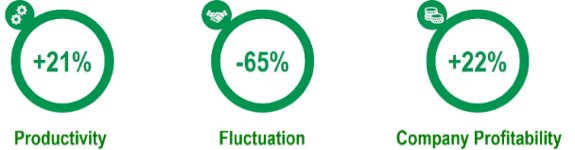
How can I establish a positive cycle of employee engagement and success in my company? Based on our consulting experience, these are the three essential tips for nurturing and maintaining employee engagement. As every company is different, be sure to tailor these tips to fit your needs! 1) Fulfill the “Basics”: Do Your Homework If you want your organization to have a strong foundation, you’ll need to start with a few sturdy building blocks. Some of these elements include good communication, job security, and work-life balance. Every decision-maker should strive to personally ensure these qualities are present in their organization and that their organization continues to adopt these practices. Unfortunately, some of the vital aspects of a strong foundation are easier to establish than others – on-boarding quality and task definition too often falls short.
- Launch a professional on-boarding for new employees It is so very important to properly integrate new employees. Only three out of ten employees claim to be well prepared for their new role after on-boarding. According to a European study, only one in ten employees say that their company is good at making it easy for new colleagues to begin. This is a radical mistake, as work performance and good on-boarding go hand-in-hand.
- Clearly outline the responsibilities of employees Often, when the actual duties and expectations of the employee are unclear, a company’s efficiency and employee responsibility are unsatisfactory. In fact, only every second employee completely understands what is expected from her/him. There’s a need to work effectively with activities, competencies, interfaces, responsibilities, and tools.
2) Take a Long-Term View – Identify and Invest in “Differentiating Factors” To further promote employee engagement, it’s imperative to identify the differentiating factors that are distinctive of your company and align your organization to these. If given proper attention these factors will be those that make the difference in employee engagement. These might range from long-term stringency of development and career opportunities, the number of exciting tasks, and/or the recognition and quality of leadership.
- Celebrate Strengths and Start the Employee’s Development Plan Early It’s never too early to talk about an employee’s career ambitions and aspirations. Organizations can and should work out a personal development plan with the employee early on, regardless of the size of your business. It’s important to invest in strength-based learning and development, because an investment in the employee sends clear signals that her/his personal development is of interest to the employer. It also shows that the organization wants to see the employee have a successful future.
- Invest in Talented Managers Every second employee has already changed jobs due to their manager, and 70% of the employee engagement scores can be explained by the leadership quality of the manager. This is why capable and well-trained leaders are needed.
3) Define and Comply with the Employer’s Purpose: Inspiring Employees A successful employer’s purpose is, and should be, key to employee engagement. Why? Employees want to be a part of something bigger – and the purpose brings this to life. Why do we believe in our company? What do we stand for? Employees who can answer these questions clearly feel, on average, much more integrated and share the willingness to work together at their best. To bring the employer purpose to life, it must be defined, understood and lived. Vivaldi has seen through our work that companies often develop their purpose based on a developed goal. However, it should actually be quite the opposite, because the employer’s promise is the company’s glue that holds it all together: customers, employees, and their entire ecosystem.
Alternative Frameworks for a Modern Workforce
The old models for measuring and managing engagement are no longer sufficient. They were built for a linear, predictable world of work that has been replaced by a dynamic, interconnected ecosystem of talent. Instead of viewing engagement as a program to be run, leading organizations see it as an outcome of a healthy system. This requires a shift in thinking—from isolated initiatives to holistic frameworks that recognize the interplay between culture, purpose, and performance. These new models aren’t just about making people happier; they are about building organizational engines that generate their own momentum and drive sustained growth from the inside out.
A Strong Company Culture, A Sense of Purpose, and Opportunities for Growth
Engagement is not a checklist item; it is the result of a thriving organizational environment. Think of it as an ecosystem where a strong culture provides the fertile ground, a clear purpose acts as the sun, and growth opportunities are the water that nourishes talent. According to insights from UKG, this combination creates the conditions for employees to invest themselves fully. When people feel they belong to a supportive culture, are motivated by a mission that matters, and see a clear path for their own development, their engagement becomes a natural and continuous output of the system you’ve built.
The Performance Flywheel: Engagement, Recognition, and Performance
Another powerful model reframes engagement not as a static goal but as part of a self-reinforcing cycle. This “performance flywheel” connects three critical elements: engagement, performance, and recognition. Deep engagement fuels high performance, which in turn should be met with specific and meaningful recognition. That validation deepens the employee’s sense of value and connection, which further strengthens their engagement. This creates a virtuous cycle of continuous improvement, where each component pushes the next, building momentum over time and transforming the organization’s performance capacity.
Key Factors That Drive Engagement
While frameworks provide the blueprint, building a truly engaged workforce requires a deep understanding of the core human drivers that motivate people today. It’s about moving beyond broad assumptions and focusing on the specific elements that make work meaningful, rewarding, and fulfilling. These factors are the essential ingredients that bring any engagement strategy to life, turning abstract concepts into tangible daily experiences for your team. By concentrating on these key areas, leaders can create an environment where employees don’t just show up—they choose to invest their best energy and ideas.
Fair Pay and Good Colleagues
Let’s be clear: competitive compensation is the price of entry. As noted by Business Leadership Today, it’s the foundational element upon which all other engagement efforts are built. But pay alone is not a sustainable motivator. The true differentiator is the quality of the team. Talented people want to be surrounded by other talented people who challenge, inspire, and collaborate with them. A workplace filled with skilled, motivated professionals creates an environment of mutual respect and collective ambition, which is a powerful force for retaining top performers and keeping them deeply engaged in their work.
Autonomy and Job Satisfaction
Micromanagement is the enemy of engagement. When you give employees genuine control over their work—the autonomy to make decisions, experiment with solutions, and take ownership of their outcomes—you foster a profound sense of pride and responsibility. Engagement soars when a job is not just a list of tasks but a meaningful challenge that aligns with an employee’s core skills and passions. This sense of mastery and impact is a powerful intrinsic motivator that drives discretionary effort far more effectively than any external reward system ever could.
Work Environment and Social Engagement
A supportive work environment extends far beyond physical safety; it encompasses psychological safety, where employees feel secure enough to voice ideas, admit mistakes, and be their authentic selves. In today’s hybrid world, fostering strong social bonds and collaborative relationships is more critical than ever. These connections are the bedrock of belonging. When people feel a genuine sense of community with their coworkers, they are more likely to feel connected to the organization’s mission and invested in its success, creating a resilient and cohesive team.
Specific Strategies to Improve Engagement
Understanding the “what” and “why” of engagement is crucial, but the real transformation happens in the “how.” Moving from theory to practice requires intentional, specific actions that are woven into the daily fabric of the organization. These aren’t one-off initiatives but sustained strategies that build a culture of engagement from the ground up. For leaders, this means shifting from managing tasks to cultivating an environment where people can do their best work. The following strategies are what leading companies do differently to turn engagement from a buzzword into a core business competency.
Systematize Recognition
Praise should not be left to chance or reserved for annual reviews. To build a culture where employees feel consistently seen and valued, recognition must become a systematic leadership practice. Leaders should make a deliberate effort to acknowledge specific achievements and contributions at least once every seven to ten days. This regular cadence transforms recognition from a rare event into a reliable part of the work experience. It reinforces desired behaviors, builds confidence, and signals to the entire team that their hard work is noticed and appreciated.
Leverage Technology as an Engagement Amplifier
Technology should be more than just an efficiency tool; it should be a catalyst for a better employee experience. With 62% of employees reporting that the right technology makes them more motivated, it’s clear that the tools you provide matter. This means offering seamless platforms for collaboration, automating repetitive tasks to free up time for more meaningful work, and providing access to online learning and development. At Vivaldi, our work in AI and New Tech Solutions helps clients design technology strategies that not only drive business outcomes but also remove friction and empower employees to contribute at their highest level.
Engage Remote and Hybrid Workers
In a distributed workforce, connection cannot be left to serendipity. Leaders must be deliberate in fostering a sense of community for remote and hybrid employees. This involves using digital platforms to share company news transparently, creating virtual spaces for social interaction, and ensuring that remote team members receive the same level of public recognition for their contributions as their in-office counterparts. The goal is to ensure that distance does not create a disadvantage, making every employee feel like an integral part of the team, regardless of their location.
Create Purpose by Connecting Employees to Customers
One of the most powerful ways to reinforce the meaning behind the work is to connect employees directly to the people they impact. Arranging opportunities for your team to hear from customers—whether through feedback sessions, testimonials, or direct interaction—makes the company’s purpose tangible and real. It transforms abstract goals and metrics into human stories of value created and problems solved. This direct line of sight to the customer closes the loop, showing employees that their daily efforts have a meaningful and positive effect on the world.
«Culture eats strategy for breakfast.» Peter Drucker
Vivaldi has helped 50+ leading companies, including American Express, E.ON and Credit Suisse, to identify their differentiating factors to develop and establish an employer purpose, to revitalize internal branding and to formulate action-oriented learning programs that shape the vision of many of today’s market leaders. Interested in learning more about Vivaldi’s organization and employee engagement offerings? Email us at hello@vivaldigroup.com. __ Sources: Brunetto, Y., Teo, S.T.T., Shacklock, K. & Farr-Wharton, R. (2012). Emotional intelligence, job satisfaction, well-being and engagement: explaining organisational commitment and turnover intentions in policing: Emotional intelligence, well-being and engagement, Human Resource Management Journal, vol. 22, no. 4, pp. 428-441. Christian, M. S., Garza, A. S. and Slaughter, J. E. (2011), Work engagement: A quantitative review and test of its relations with task and contextual performance. Personnel Psychology, 64: 89–136. Grant A., Christianson M. & Price R. (2007). Happiness, health, or relationships? Managerial practices and employee well-being tradeoffs. Academy of Management Perspective 21(3), 51–63. Imperatori, B. & SpringerLink (2017). Engagement and Disengagement at Work: Drivers and Organizational Practices to Sustain Employee Passion and Performance, Springer International Publishing, Cham. Macey, W. H. and Schneider, B. (2008). The Meaning of Employee Engagement. Industrial and Organizational Psychology. Cambridge University Press, 1(1), pp. 3–30. Robinson, D., Perryman, S., Hayday, S. & Institute for Employment Studies (2004). The drivers of employee engagement, Institute for Employment Studies, Brighton. Stairs, M., and M. Galpin. (2010). Positive engagement: From employee engagement to workplace happiness. Oxford handbook of positive psychology and work, 155-172.
Frequently Asked Questions
Why should senior leadership focus on employee engagement? Isn’t that HR’s job? While HR plays a vital role in facilitating engagement initiatives, treating it solely as a departmental function is a strategic mistake. Engagement is the current of discretionary energy that powers your entire business. When it’s low, it acts as a silent tax on every strategic goal, from innovation to customer experience. C-suite leaders must own the architecture of engagement because it is directly tied to profitability, growth, and competitive advantage. It’s not an HR metric; it’s a core component of the organization’s growth engine.
We already run annual engagement surveys. Why aren’t we seeing results? An annual survey is like taking a single photograph of a moving train—it gives you a snapshot in time, but it doesn’t change the train’s direction or speed. Surveys are diagnostic tools, not solutions. Real change happens when you move from measuring engagement to actively creating the conditions for it. This involves building a culture of systematic recognition, connecting daily work to a clear purpose, and ensuring leaders are equipped to foster psychological safety and autonomy within their teams.
What’s the difference between employee engagement and just keeping employees happy? Happiness is a feeling of contentment, but engagement is a state of commitment. A happy employee might enjoy the perks and their colleagues, but an engaged employee is intellectually and emotionally invested in the company’s success. They don’t just perform their tasks; they actively look for ways to improve processes and drive the business forward. While engagement often leads to happiness, a focus on happiness alone won’t necessarily create the proactive, problem-solving workforce that defines market leaders.
How do these principles apply to a hybrid or fully remote team? In a distributed workforce, the principles of engagement become even more critical, but their application requires more intention. “Physical and behavioral engagement” is no longer about office presence but about proactive participation in digital channels, collaborative problem-solving, and demonstrating ownership over outcomes. Leaders must be deliberate about creating connection through transparent communication, virtual community-building, and ensuring remote team members receive equal recognition for their contributions.
What’s the single most impactful thing a leader can do to improve engagement on their team? If you do only one thing, make recognition a consistent, systematic practice. Don’t wait for annual reviews. Acknowledging specific contributions and efforts in a timely manner—ideally, at least once a week—is incredibly powerful. It validates an employee’s effort, reinforces their connection to the company’s goals, and builds the emotional capital that fuels resilience and discretionary effort. It’s a low-cost, high-impact behavior that directly addresses the human need to feel seen and valued.
Key Takeaways
- Channel Human Energy as a Strategic Asset: Stop treating engagement as a metric to be managed and start seeing it as the core energy source for your business. True growth happens when you intentionally align your team’s cognitive clarity (the “why”), emotional connection (the “feel”), and behavioral drive (the “do”).
- Design an Ecosystem, Not a Program: Engagement isn’t the result of perks or surveys; it’s the natural output of a healthy organizational system. Focus on building the foundational elements—a strong culture, a clear purpose, and real growth opportunities—and deep engagement will follow as an outcome.
- Turn Theory into Daily Leadership Practice: The most effective strategies are built on consistent, intentional actions. Systematize recognition so it’s frequent and specific, grant genuine autonomy to foster ownership, and constantly connect your team’s work to the customers they impact.
Related Articles
- Employee Engagement: 3 Key Imperatives For Your Organization
- Take a Deep Dive into the Future of Work | VIVALDI
- Redefining Productivity in the Remote Era with Bruce Daisley – Vivaldi Group
- The Future of Employee Experience – Vivaldi Group
- The Future of Work, with Alejandro Melamed – Vivaldi Group