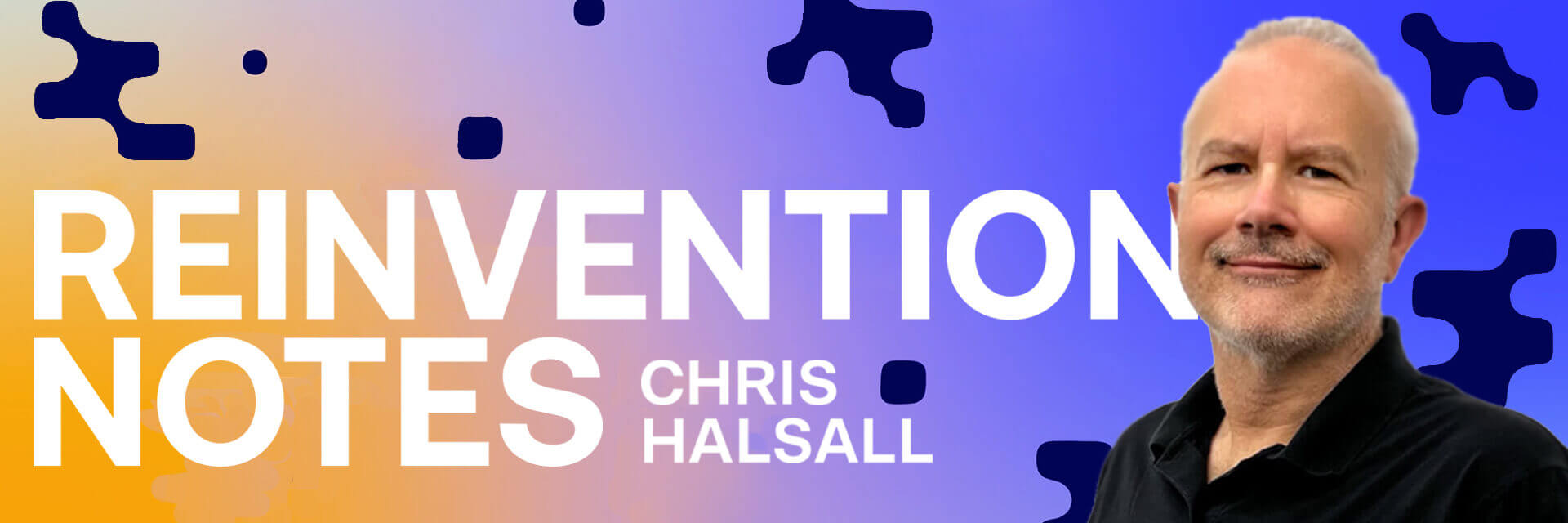
There’s an old joke about two friends who encounter a bear in the woods. One immediately starts running, while the other calmly changes into running shoes. “You can’t outrun a bear,” the first friend yells. The second replies, “I don’t have to outrun the bear. I only have to outrun you.” In a compelling new analysis, Vivaldi Senior Partner Chris Halsall argues this is the perfect metaphor for marketing’s relationship with AI. The goal isn’t to out-think or out-create the machine—that’s a losing battle. The real strategic imperative is to outmaneuver your competitors who are facing the exact same disruption. This isn’t another article about AI’s capabilities; it’s a playbook for reinventing your marketing function to be faster, smarter, and more effective than the other humans in the race.
Two friends are in the woods, having a picnic. They spot a bear running at them. One friend gets up and starts running away from the bear. The other friend opens his backpack, takes out his running shoes, changes out of his hiking boots, and starts stretching. “Are you crazy?” the first friend shouts, looking over his shoulder as the bear closes in on his friend. “You can’t outrun a bear!” “I don’t have to outrun the bear,” said the second friend. “I only have to outrun you.” With this month’s Reinvention Notes I would like to connect a couple of random things I read recently to the need for marketing reinvention. The gist of these articles was, AI is getting smarter, and humans are getting dumber. “Argh”, you say… “not another AI article”. Well yes and no, this is really much more about us. About how for too long we have been complacent in accepting mediocre marketing and an outmoded marketing function. AI is just the catalyst that is now forcing an overdue discussion on the need for marketing reinvention. So, let’s get started by getting you up to speed on the articles that I’ve based this post on. We’ll get to how the bear jokes fits in to everything a bit later.
Is AI Already More Creative Than Us?
A recent study has shown that AI may now be better at innovation than humans – at least at the early stages of ideation. The research suggested that AI beat people in both the quantity and quality of ideas generated. We’ve known for a while now that AI is superior at many basic things, but it may come as a surprise that it is now better than us at coming up with ideas. Or maybe it’s not surprising. I’m sure you have participated in your fair share of workshops where, “there are no bad ideas”. But of course, there are bad ideas. Which is probably why fewer than 10% of startups will see a positive return – and remember, these are the ideas that made it out of the conference room.
Are We Outsourcing Our Brains?
After about a million years of continuous growth, the human brain has apparently stopped growing. In fact, new research suggests it has started shrinking – significantly, in just the last couple of thousand years. In evolutionary terms, a thousand years is a remarkably short time. Ironically, scientists theorize that this rapid reduction in relative brain mass can be attributed to our success in building a sophisticated, collective civilization with specialized roles and codified retained knowledge. Essentially, our prehistoric ancestors were forced to use their brains independently to get themselves out of tight spot, whereas we can rely on our collective intelligence without needing to tax our brains as much. Since our brains are not very energy efficient, evolution has started to redirect these resources elsewhere. At the risk of overly simplifying this – your smart phone is making you stupid.
The Real Problem AI Exposes in Marketing
I said I would tie these threads together for marketing reinvention, so let’s recap where we’re at…AI is getter smarter, faster than we thought, while our brains are rapidly shrinking and we’re probably getting dumber*. Well, we had a good run. Before we throw in the towel to our AI overlords, what if the problem is not that we’re getting dumber and just that we have been a bit…lazy? I know that’s not really trading up in virtues but hear me out. Maybe AI is just shining a light on a much bigger issue that we have been complicit in as marketers. We have structured our marketing function and processes to value activity over outcomes. To highlight this, let me draw an analogy between marketing and manufacturing. In the ‘80s, Japanese automakers revolutionized manufacturing by doing some relatively simple things well. One was to get rid of buffer inventory. The theory was, if you have easy access to component inventory at each stage of production, you never fix the systemic inefficiencies in your process. For the last 30 years, we have never really fixed the systemic inefficiencies in the marketing function – we have not done “Lean”. By and large we have benefited from economic forces that have created an abundance of demand, and as a result, our marketing capabilities have atrophied. But these updrafts are waning, and we will now have to work smarter. Excess consumer demand created by the emerging global middle class has plateaued. The digital economy has matured and there are fewer and fewer opportunities to truly disrupt or to fast follow into new growth. For most of our careers as marketers (and consultants), we have not been forced to fundamentally reinvent how we do things to succeed. Now we have to.
Two Principles for a Marketing Reinvention
So let’s get started by establishing a couple of principles for how we will tackle this.
- Skate to where the puck is going
- This is bigger than AI
Principle #1: You Don’t Have to Outrun the Bear
This is how Wayne Gretzky summed up the secret of his success in hockey. If you skate to where the puck is right now, by the time you get there it will be too late – the play will have moved on. Similarly, if you redesign your marketing function to take advantage of the AI capabilities that exist right now, by the time you retool your marketing function, it will already be obsolete. To imagine where the AI puck is going, a little thought experiment may be helpful. Thought experiments are often used in physics to imagine what could be possible. If you have ever interviewed with a consulting firm, you might have been asked a type of thought experiment to assess your problem-solving abilities. One I was given was, “If electricity is free, how much does a lawn mower cost?” In the context of reinventing the marketing function, our question could be, “if you have an unlimited capacity of average marketing (i.e.; from AI), what exceptional things should your human marketers be focused on?”, or even, “What are the 5 things we do today that cause the most pain for my team?” Whatever questions you use to think through the division of human versus artificial labor, the key is to create clear swim lanes, for example:
- Activities deferred to AI
- Activities augmented by AI
- Purely human activities
Remember this is not about becoming smarter than AI (because as we’ve established, that’s a losing battle), this is about working smarter than the other humans at your competitors. And that’s how we connect this back to the bear joke that opened this blog. You don’t need to outrun the bear (AI), you just need to outrun the other human.
Principle #2: Ask “What,” Not Just “Who”
If you center the redesign of your marketing function around who does what (humans versus AI), things may actually get worse instead of better. Much like our manufacturing example, just throwing free/cheap AI labor at low value work, just masks the real question – should anyone, human or otherwise being doing this, or should you just stop doing it? The question of “what” you do – to create advantage, to find growth, as the low-hanging fruit disappears, is far more important than who does it. AI is just a catalyst for tackling the big thorny questions about “what” your marketing function should be focused on. But unpacking “what” your specific team needs to be great at, is a bigger topic than we can cover in this post. As you might imagine, Vivaldi has an approach for answering this question, so please contact us if you are interested in learning more. Thanks for reading and see you again soon. * I should note here in the fine print, that we don’t yet know if our smaller brains are any less capable. It may just be that evolutionary improvements in our brain’s circuitry allows us to do the same (or more) with less mass. But since that possibility didn’t support the point I was making, I am including it here in the footnotes.
About the Author: Chris Halsall
Professional Background and Experience
A Career Spanning 25+ Years in Global Consulting
Chris Halsall is a Senior Partner at Vivaldi Group, bringing over 25 years of dedicated experience as a global consultant. His career is built on guiding some of the world’s most ambitious organizations through complex market shifts and technological disruptions. This extensive tenure has given him a deep understanding of what it takes to build resilient brands and drive sustainable growth across diverse industries. Chris’s work is defined by a practical, results-oriented approach that translates high-level strategy into tangible business outcomes, making him a trusted advisor to C-suite executives facing their toughest challenges. You can learn more about his role and perspective on his official Vivaldi profile.
Leadership Roles at Vivaldi, Ogilvy, and McKinsey
Before joining the leadership team at Vivaldi, Chris was instrumental in launching Ogilvy Consulting, where he served as a key leader. His impressive background also includes time at the prestigious consulting firm McKinsey & Company, where he honed his strategic capabilities. This blend of experience—from helping build a consulting practice from the ground up to advising clients at one of the world’s top firms—gives him a unique perspective on both entrepreneurial agility and enterprise-level transformation. His leadership has consistently focused on helping organizations build the internal capabilities needed to not just compete, but to lead their categories and define the future of their industries.
Areas of Expertise and Notable Clients
Focus on Enterprise Transformation and Growth
Chris specializes in helping companies find new pathways to growth at the dynamic intersection of consumer behavior, emerging technology, and business strategy. He excels at helping leaders reframe their challenges and identify opportunities for profound change. His work often involves architecting comprehensive enterprise transformations that align brand purpose with operational reality. By focusing on the human element of change alongside the technological and commercial imperatives, Chris helps organizations build strategies that are not only powerful on paper but are also successfully adopted and executed by their teams, creating lasting value and competitive advantage in the market.
Advising Global Industry Leaders
Throughout his career, Chris has advised an incredible roster of global industry leaders across more than 30 countries. His client list includes iconic brands such as Ford, IBM, Microsoft, Nestle, and Samsung. He has also provided strategic counsel to major organizations like the United States Army, demonstrating his ability to adapt his expertise to vastly different operational contexts and strategic goals. This extensive and varied experience has equipped him with a rich repository of insights into the universal principles of growth and the specific nuances of individual sectors, allowing him to deliver highly relevant and impactful guidance to every client he partners with.
Education and Publications
Academic Credentials
Complementing his extensive hands-on experience, Chris holds an MBA from Western University. This strong academic foundation in business administration and strategy provides a rigorous framework for his consulting work, ensuring that his creative and forward-thinking solutions are also grounded in sound business principles. His education has been a cornerstone of his ability to dissect complex business problems, analyze market dynamics, and develop robust strategies that stand up to the pressures of a constantly evolving global marketplace. This blend of academic knowledge and real-world application is central to his effectiveness as a strategic advisor.
Authored Works on Marketing Accountability
Chris is a recognized thought leader who has contributed to the broader conversation on marketing effectiveness. During his time at Prophet, he co-authored the book The Marketing Accountability Imperative, a work that explores how marketing functions can deliver and demonstrate greater value to the business. This publication underscores his long-standing commitment to transforming marketing from a cost center into a powerful engine of growth. His focus on accountability and performance is more relevant than ever, providing a critical perspective for leaders looking to enhance their marketing and sales enablement efforts in an increasingly data-driven world.
A Note on Disambiguation
Clarifying Identity
When searching for Chris Halsall, you may come across a different individual, also known as Major Chris Halsall, who is known for appearances in television shows and documentaries. While he shares the same name, he is not the author of this piece. The Chris Halsall sharing his insights here is Vivaldi’s Senior Partner and a global growth strategist dedicated to helping businesses thrive. We hope this clarification helps ensure you’re following the right expert for insights on brand strategy, business transformation, and marketing reinvention. It’s a small world, but it’s important to make sure you’re connecting with the right voice!
Frequently Asked Questions
So, is the goal to replace my marketing team with AI? Not at all. The goal is to refocus your team on what humans do best. Think of AI as a tool that can handle the high-volume, repetitive, or data-intensive tasks that currently bog your people down. This frees up your team’s time and brainpower for more strategic work—like interpreting complex customer insights, making nuanced judgment calls, and building the essential relationships that AI can’t replicate. It’s about making your team smarter and faster than your competitors, not replacing them.
If AI is already better at generating ideas, what’s left for human marketers to do? This is the critical question. While AI can produce an incredible quantity of ideas, it lacks true understanding, strategic context, and emotional intelligence. The future role of human marketers is to become the conductors of this powerful orchestra. They will be the ones who set the strategy, ask the right questions, curate the best of what AI generates, and weave it all into a cohesive brand story that connects with people on a human level. AI provides the raw material; your team provides the vision and wisdom.
This all sounds great in theory, but what’s the first actionable step my team can take tomorrow? A great place to start is with a simple “pain audit.” Sit down with your team and identify the top five most tedious, time-consuming, or low-value tasks they perform regularly. This could be anything from pulling data for weekly reports to writing first drafts of social media posts. This exercise immediately highlights the best opportunities to test AI tools. It’s a practical, low-risk way to begin reinventing your processes without overhauling the entire department overnight.
Can you give a real-world example of the “swim lanes” for AI and human activities? Of course. Let’s say you’re launching a new product campaign. The lane for activities deferred to AI could be analyzing thousands of customer reviews to identify common themes or generating 50 different ad copy variations. The lane for activities augmented by AI might involve a strategist using an AI tool to visualize market segmentation data. The purely human lane would be the final decision on the campaign’s core emotional message and the creative vision that will define the brand’s connection with its audience.
How do we start identifying the low-value work we should stop doing altogether? This requires a shift in mindset from “who does this?” to “why do we do this at all?” Challenge every process and report. For each task, ask your team, “If we stopped doing this tomorrow, what would be the actual negative impact on our business goals?” You’ll likely find that many activities are done out of habit rather than strategic necessity. Using AI as a catalyst for this conversation helps you cut the fat and focus your entire function—both human and machine—on what truly creates value.
Key Takeaways
- Outmaneuver Your Competition, Not AI: The strategic race isn’t against the machine; it’s against other leaders. Use AI as the catalyst to shed outdated marketing processes and build a faster, more effective team than your rivals.
- Eliminate Inefficient Work, Don’t Just Automate It: Before assigning tasks to AI, ask if they should exist at all. True transformation comes from stopping low-value activities, not just making them faster, freeing up your human talent for what matters.
- Build Your Team for Where AI Is Going: Designing your marketing function around today’s AI capabilities ensures you’ll be obsolete tomorrow. Instead, anticipate future advancements and strategically define the distinct roles for purely human activities, AI-augmented tasks, and fully automated work.
Related Articles
- Redefining Marketing in the AI Era with Chris Halsall
- Vivaldi Group and Silverside AI Join Forces for Brand Transformation in the AI Era – Vivaldi Group
- Marketing Transformation Strategy Consulting Services
- The Changing Role of the CMO | Vivaldi
- Reinventing Brand Strategy: Holistic Branding – Vivaldi Group