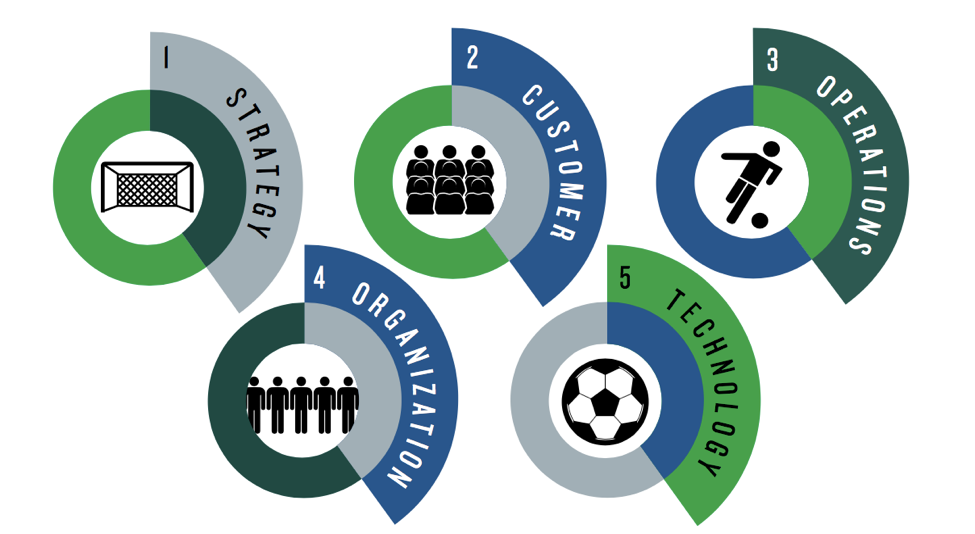
In The Changing Role of the CMO: Evolution and Revolution at Work, Vivaldi conducted a study in order to understand the rapid changing roles of the CMO. The study revealed five core topics that are essential to the marketing function:
- Strategy
- Customer
- Operations
- Organization
- Technology
A sports analogy was landed on to accompany the findings throughout the study. The most analogues sport was established as soccer. The former way of marketing was similar to American Football, running a play, regrouping, running the next play, and repeating, until you score.” However, the industry has become increasingly more and more dynamic, and thus has become more like soccer, “where strategies are determined in real time as the landscape is redefined with each move.”
Marketing has changed shape. It is no longer solely about promoting products as in the world of Mad Men. It is now more about being about co-creating and shaping products as well as constantly promoting them throughout every step of the process. This requires; shaping the strategy, spotting new growth opportunities and being accountable for market success.
CMOs used to be big shots in big offices. Now their success is less about them and more about the customers. In other words, “successful SMOs morph into their customers – and become their voice.” With consumers assuming control of brands and markets, CMOs must adjust to consumers “armed to their teeth,” create a good story and establish a focus on consumer-centric planning.
“These days, marketing has morphed into a sport more akin to soccer – a game where strategies are determined in real time as the landscape is redefined with each move.”
Another shift in the role of the CMO involves adjusting to the real time nature of the contemporary consumer. CMOs need to constantly be thinking on their feet. The inclusion of technology has made data collection more difficult and the timeline for analysis and decision-making has been accelerated. As a result, “the decision-making pyramid is gone,” CMOs are forced to understand, “a constant flow of customer learnings, interactions and adjustments,” and “identify consumers by their behaviors and across the consumer journey.”
CMOs no longer rival CFOs. There is no need to wrestle over spending anymore, since marketing has proved its inherent value. Now the challenge is simply to get things done. In order to meet these needs, “the CMO’s team needs players with a variety of skill sets – not just traditional marketing.” CMOs need to be digitally and technologically adept in order to keep up with perpetually changing consumers. These facets of the CMO’s role require; “cooperation and spending their budgets with maximum impact,” as well as, “leading a multi-disciplinary team.”
Perhaps the most important change that the role of the CMO has undergone is the shift from demographics to individuals. Understanding and targeting demographics and psychographics is no longer enough. CMOs need to connect with consumers on as close to an individual basis as they possibly can. This dynamic approach, is comprised of, “knowing how to analyze the data,” understanding and accepting that, “marketing is increasingly a quantitative discipline,” as well as, “creating a two-way dialogue fosters lasting customer commitment.”
“Making the right calls requires more than crunching data, namely adding meaning to the data and developing a perspective, a perspective that is subject to change quickly due to changing conditions in the field and needs to be broken down and understood on the ground.”
The conclusion arrived at from this research is that CMOs must update their capabilities and skills. Among these are; analytical acumen, commercial instincts and a collaborative mindset. Commercial instincts enable shaping the value chain, increasing yield and pushing the sales team to understand the value of mining Big Data. A collaborative mindset is absolutely necessary. In the complex contemporary realm of marketing, nobody can do it alone. Analytical acumen is comprised of social media and multi-channel management, deep reliance on segmentation and precision targeting. Mastering or neglecting to master these skills and capabilities can be the difference between a successful and an unsuccessful CMO.