
AI is moving competition upstream, to the point where demand forms, before anyone has chosen a category.
For forty years, marketing has been organized around a sequence that almost nobody questions. A need arises, the customer turns to a category, and only then does competition begin. Brands fought for attention inside that category, moving people from awareness to consideration to preference to purchase. The channels changed from television to search to social to retail media, and measurement became far more precise, but the starting point never moved. The customer did the work of translating her life into the language of the market. The market waited at the other end.
Generative AI changes who does the translating. A traveler no longer has to type “Italy, July, four bedrooms, pool, under $800.” She can describe her situation instead: the children are older now, we have one week together next summer, everyone needs some independence, we care about food and swimming, I don’t want a resort, and I don’t want to spend the week organizing everyone. That is not an accommodation query. It contains a destination decision, a lodging decision, a restaurant decision, and a decision about how much of the trip to organize at all. An agent can work with that sentence. A search box never could.
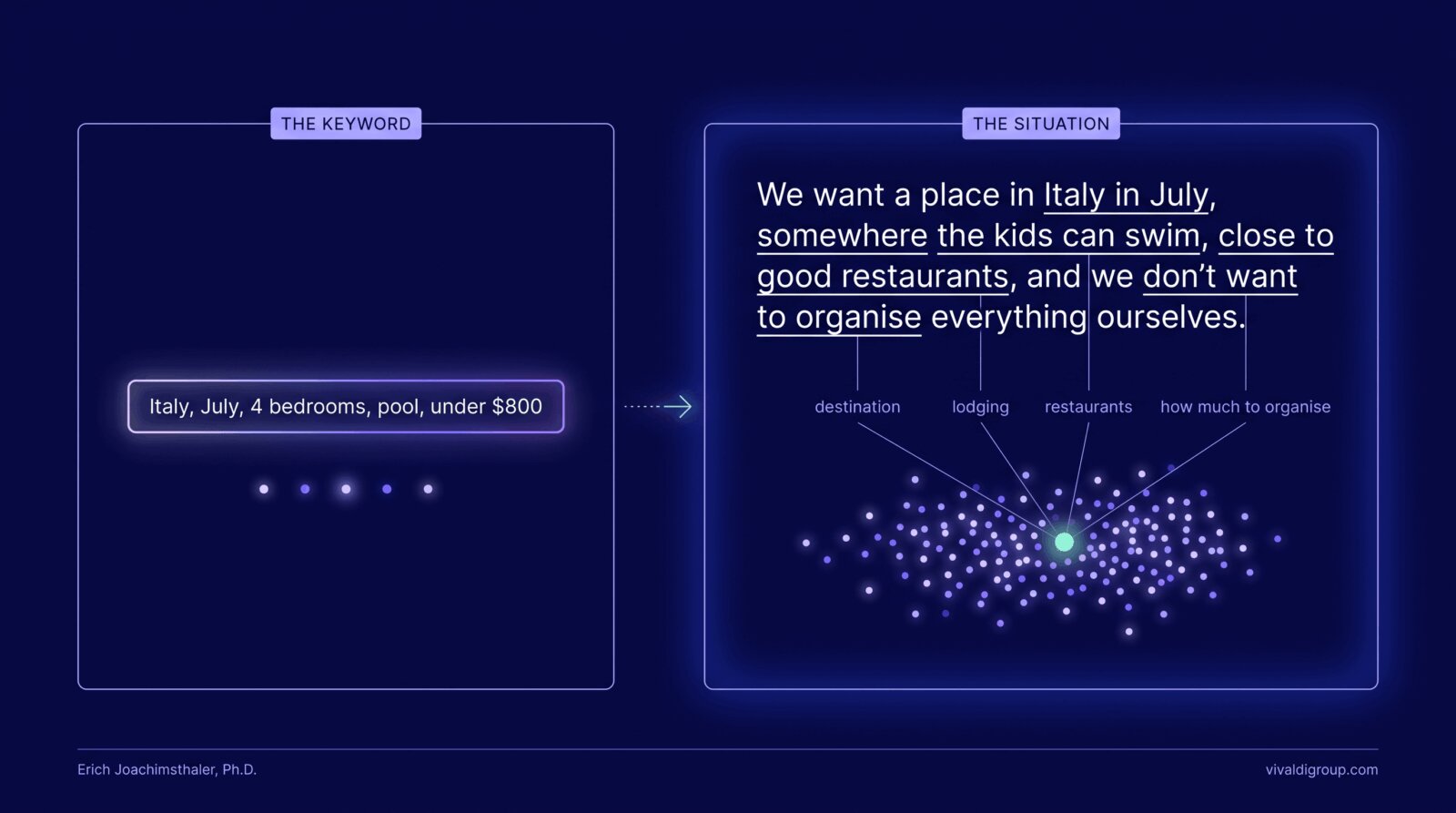
A keyword carries one query. A situation carries four decisions an agent can work with.
When the agent interprets the situation rather than the keyword, competition moves upstream, to the stage where intent is still forming. Companies that understand that stage will influence which categories are considered in the first place. Companies that understand only the final query will compete for whatever is left.
The journey was never a funnel. Now we can see it.
The best behavioral evidence comes from travel. Skift Research and McKinsey published a study in September based on a survey of more than 1,000 U.S. travelers and on diaries in which 26 participants documented 211 research and booking sessions. The average journey now runs to about 65 touchpoints before booking, against roughly 45 when McKinsey last mapped it in 2018. Nearly half of travelers changed their hotel choice after they had already booked. Destinations entered consideration before travelers had dates, a budget, or in some cases a firm intention to travel at all. [1]
The funnel assumed that intent is formed once and then executed. The diaries show something else. Intent develops, reverses, and reforms through interaction with content, with other people, and increasingly with AI. A company that sees only the final search sees the last few minutes of a process that started weeks earlier, often in a different category.
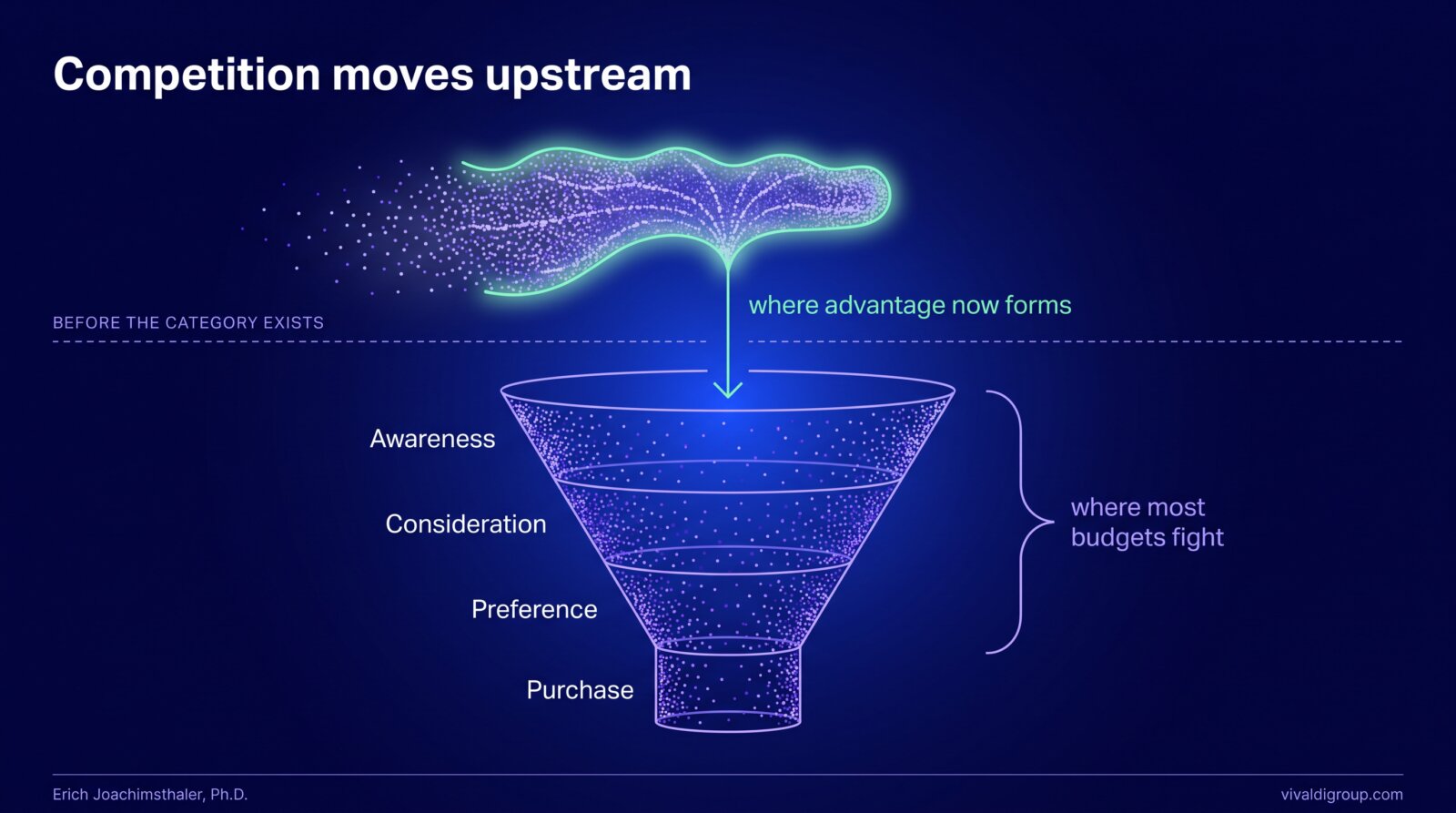
Competition moves upstream, to the point where intent forms before a category is chosen.
The commercial data points in the same direction. Adobe Analytics, which tracks more than a trillion visits to U.S. retail sites, reported that traffic from AI assistants rose 393 percent year over year in the first quarter of 2026. In March 2026, AI-referred visitors converted 42 percent better than visitors from other sources and generated 37 percent more revenue per visit. Twelve months earlier, the same traffic had converted 38 percent worse. [2] I would not read this as proof that AI creates better customers; much of it is selection. But the mechanism is plausible and important. A shopper who arrives after describing what she is trying to accomplish arrives further along than one who typed a keyword.
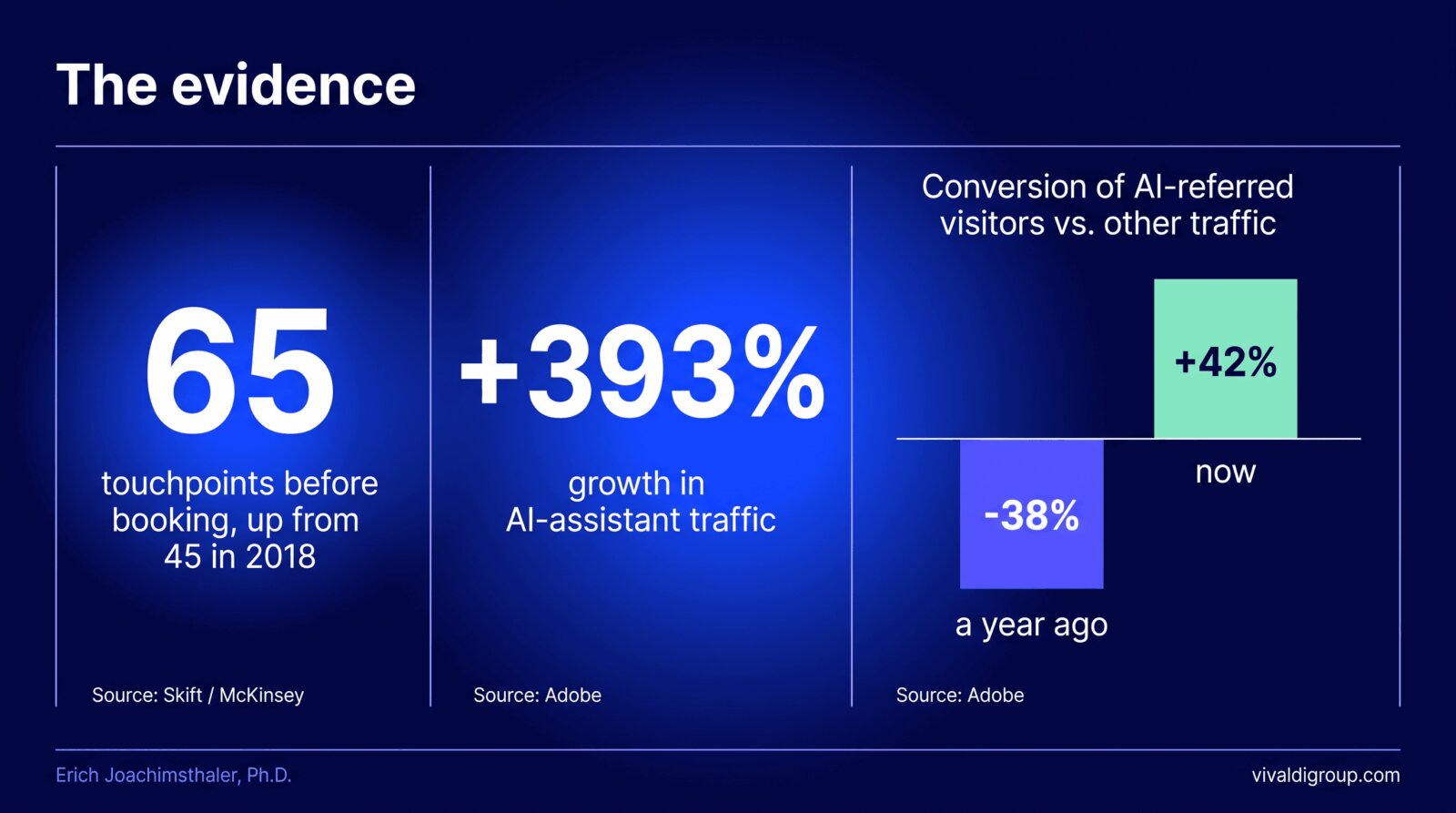
Sources: Skift Research and McKinsey & Company, 2026; Adobe Analytics, Q1 2026 retail data.
Airbnb: from filters to situations
Airbnb is building toward this explicitly. Its AI search lets guests describe a trip in ordinary language and turns the description into the attributes that matter. Mention a baby and the system can bring forward cribs, nearby playgrounds, and toys, without the guest having to know which of dozens of filters to tick. Brian Chesky has described a further step in which Airbnb itself becomes an agent that eventually negotiates with other agents. [3]
The interesting part is not the interface. It is that the unit of analysis changes from the listing to the situation. A family trip with a toddler, a reunion of college friends, and a month of remote work in Lisbon are different demands that happen to draw on the same inventory. A platform that understands the situation can assemble supply around it. A platform that understands only the listing has to wait for the guest to do that assembly herself.
Walmart: one birthday party, not five categories
Walmart makes the same point with less glamour. Suppose a parent searches separately for balloons, paper plates, cake mix, party bags, and a gift. To a retailer’s systems, these are five searches in five categories, each with its own merchandising logic, its own media budget, and its own category manager. Now suppose she says: help me organize a birthday party for eight ten-year-olds this Saturday. The categories disappear and the demand becomes visible.
Walmart’s Sparky assistant is designed for exactly this. On the company’s fourth-quarter call in February, CEO John Furner said that customers who use Sparky have average order values about 35 percent higher than those who don’t, and described the assistant as connecting digital intent to fulfillment. [4] The number is observational, not a controlled comparison, and heavier shoppers are more likely to try new tools. The mechanism is still the point. The agent sees one birthday party where the retailer used to see five categories.
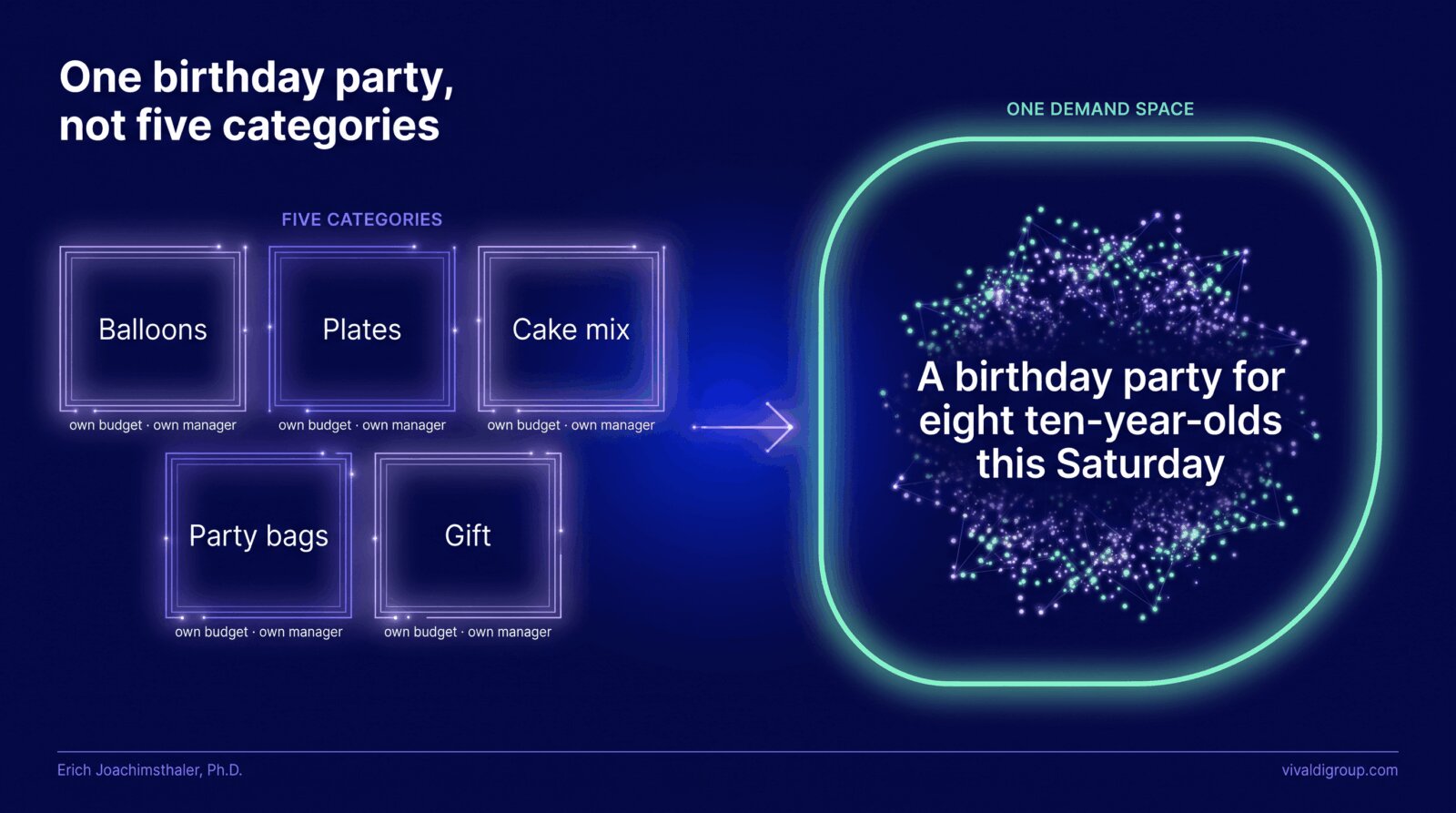
The retailer sees five categories. The customer is planning one birthday party.
This is what I have called a demand space since my work on demand landscaping in the early 2000s and in Hidden in Plain Sight. A demand space is not a segment and it is not a category. It is a recurring, meaningful episode in people’s lives in which a specific context, motivation, and desired outcome create demand. It has five elements: the context, the motivation (functional, emotional, and social), the desired outcome, the behavior (current solutions and alternatives), and the economic opportunity (size, frequency, value, growth, and willingness to pay). Categories describe how companies organize supply. Demand spaces describe how people experience demand. [5]
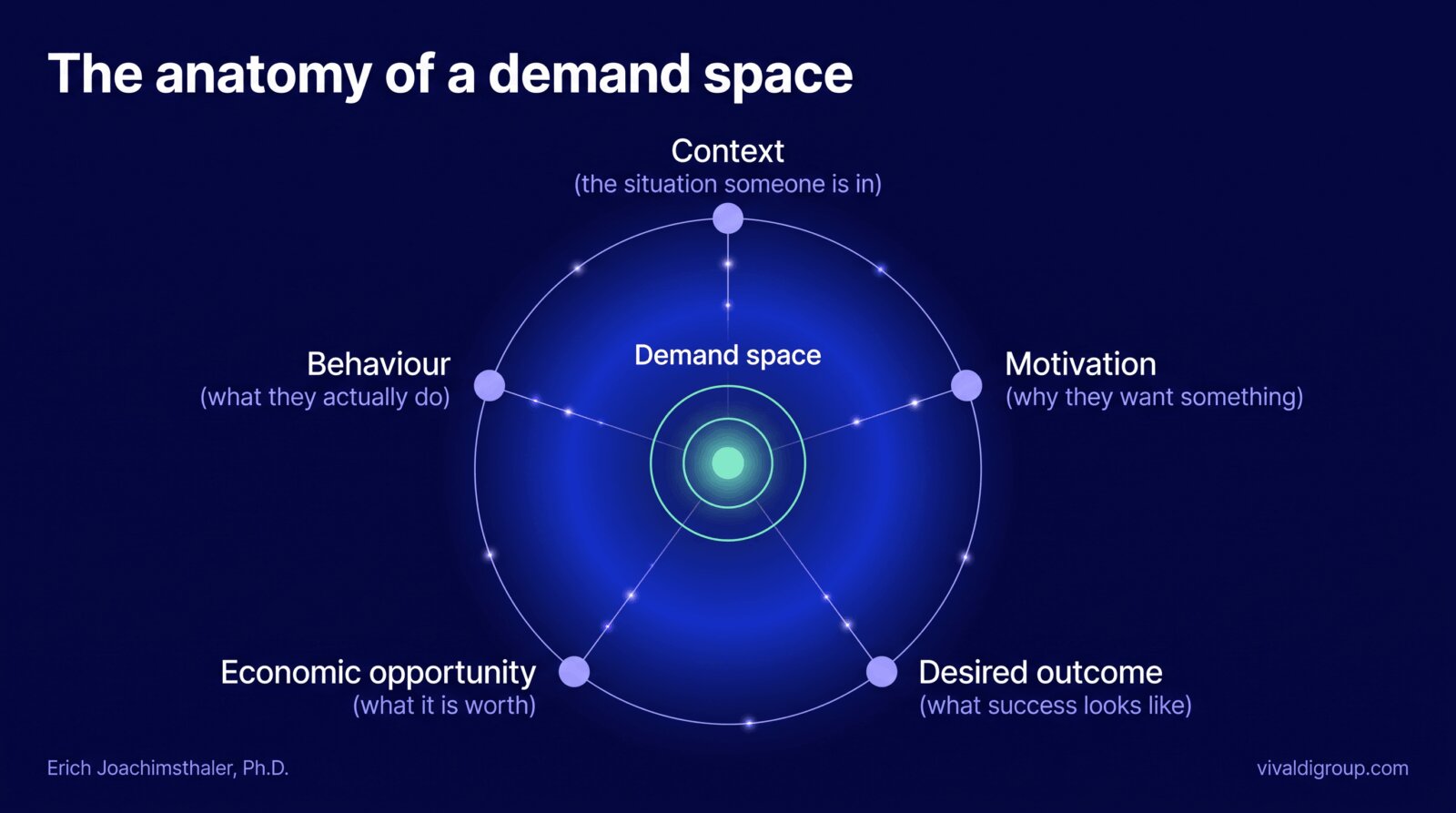
The five elements of a demand space: context, motivation, desired outcome, behaviour and economic opportunity.
None of this is new to consumer psychology. Lawrence Barsalou showed in the early 1980s that people readily form what he called ad hoc and goal-derived categories, such as “things to take on a camping trip” or “foods to eat on a diet,” and that these categories are as stable and as useful to people as taxonomic ones. [6] Ratneshwar and colleagues extended the idea to consumer choice in 2001. [7] People have always organized choice around goals. Companies organized around supply because serving goal-shaped demand was too expensive. AI lowers that cost.
Intent is not a demand space
There is a risk in the current excitement about intent. Intent is individual, and strategy cannot be built around millions of unique prompts.
One person writes: I want something interesting to drink tonight, but not a heavy evening. Another: I’m meeting two friends after work and want something a little special, but it isn’t a big night out. A third: I want to celebrate, but I need to be functional tomorrow morning. The words differ. The structure underneath them is close to identical: a social occasion with a ceiling on consequences, where the drink must carry some meaning without carrying the night.
That recurring structure is where strategy begins. The agent may know each individual extremely well. The enterprise still has to know which recurring forms of demand exist, how large they are, what people pay in them, and which ones it can serve better than anyone else. Demand Architecture turns millions of individual expressions of intent into a small number of patterns a company can actually invest against. Agents understand people. Demand spaces help companies understand markets.
The same shift in B2B
This is not only a consumer story. Corporate software is sold in categories: expense management, accounts payable, procurement, vendor management, contract management. The finance leader’s problem rarely respects those boundaries. It sounds more like: different teams buy the same services at different prices, procurement takes too long, and nobody knows where we have leverage.
In April, Ramp launched a set of AI agents that triage purchase requests, source vendors, generate and score RFPs, run security, legal, and financial checks before a request reaches an approver, and review contract terms against anonymized pricing benchmarks drawn from its transaction data. Ramp reports that customers using the system save an average of 16 percent a year on vendor costs and eliminate 46 hours a month of manual purchasing work. [8] These are company figures and should be read as such. What matters here is the structure of the offer. The customer is not buying a category of software. She is hiring a solution to a recurring business episode.
Industrial markets have the same blind spot. A manufacturer believes it sells equipment while the customer is trying to eliminate unplanned downtime. A logistics company believes it sells freight while the customer is trying to take uncertainty out of a critical supply chain. Most B2B companies know their product categories in great detail and know remarkably little about the demand that brings customers into them. AI makes that gap visible, and it makes it expensive.
Why this is a growth question, not a media question
Marketing has spent two decades becoming very good at intercepting demand that already exists. Search finds the customer after she searches. Retail media finds her after she enters the category. Performance marketing optimizes the last few steps before conversion. All of this will continue to matter, but it is where the margin is being competed away.
The growth arithmetic has never favored the late stage anyway. McKinsey’s analysis of growth in large companies found that market share gains account for only about 7 percent of corporate growth. [9] Most growth comes from being positioned in the right parts of the market, and from moving there before others do. When AI takes over more of discovery and comparison, the value of decisions made before that stage goes up: which demand matters, which demand is growing, which demand is changing structurally, and which demand we are uniquely equipped to serve. Those are capital allocation questions. They should not be left to the media plan.
Three questions for leadership
- What demand exists before the category is chosen, and how much of it do we currently see?
- Which recurring demand spaces sit beneath the individual expressions of intent we are collecting?
- Where is structural change creating new demand spaces before our existing research detects them?
The third question is where Vivaldi’s Structural Change Index comes in. Even categories that look stable on the surface have significant tidal movement in demand underneath. I will return to that in the third article.
For years the question was how to capture attention. The harder question now is what demand exists before the customer has decided what to buy, and which of it deserves our investment.
Notes
- [1] Skift Research and McKinsey & Company, “Winning Hearts in an Age of Infinite Travel Choices,” September 2026. See McKinsey press release, October 8, 2026 and ANI report, September 26, 2026.
- [2] Adobe Analytics, Q1 2026 retail traffic data, reported in “AI traffic to US retailers rose 393% in Q1, and it’s boosting their revenue too,” TechCrunch, April 16, 2026.
- [3] “Airbnb adds AI search, more social features,” TechCrunch, September 30, 2026; “Brian Chesky interview: AI agents need their own operating system,” TechCrunch, 2026. https://techcrunch.com/2026/10/01/brian-chesky-interview-ai-agents-need-their-own-operating-system/
- [4] Walmart Inc., fourth-quarter fiscal 2026 earnings call, February 19, 2026, remarks by CEO John Furner; reported in Constellation Research, “Walmart’s Sparky AI agent increases order value”.
- [5] Erich Joachimsthaler, Hidden in Plain Sight: How to Find and Execute Your Company’s Next Big Growth Strategy (Boston: Harvard Business School Press, 2007); Erich Joachimsthaler, “The Attention Economy Is Ending. Growth Now Runs on Intent,” Medium, January 2026.
- [6] Lawrence W. Barsalou, “Ad Hoc Categories,” Memory & Cognition 11, no. 3 (1983): 211–227; Lawrence W. Barsalou, “Ideals, Central Tendency, and Frequency of Instantiation as Determinants of Graded Structure in Categories,” Journal of Experimental Psychology: Learning, Memory, and Cognition 11, no. 4 (1985): 629–654.
- [7] S. Ratneshwar, Lawrence W. Barsalou, Cornelia Pechmann, and Melissa Moore, “Goal-Derived Categories: The Role of Personal and Situational Goals in Category Representations,” Journal of Consumer Psychology 10, no. 3 (2001): 147–157.
- [8] Ramp, “Ramp Launches Fleet of AI Agents Across Its Procurement Platform,” press release, April 29, 2026; reported in CPA Practice Advisor, May 1, 2026. Figures are company-reported.
- [9] McKinsey & Company, “NOW NEW NEXT: How Growth Champions Create New Value,” 2016.