
Digital Transformation Consulting: What to Expect and How to Choose the Right Partner
Most organizations approach digital transformation consulting the way a first-time homebuyer approaches a renovation: with more optimism than information. They know change is necessary, they know it will cost more than they think, and they are not entirely sure what they are buying. The result, in transformation as in renovation, is often a finished product that looks nothing like what was promised and costs far more than the original estimate.
Ready to explore what an integrated transformation approach looks like for your organization? Talk to Vivaldi’s team and get a clear-eyed assessment of your transformation readiness.
This guide is for enterprise leaders who want to do it differently. Whether you are a CMO trying to understand what a digital transformation consulting engagement actually delivers, or a CTO evaluating firms for a multi-year program, what follows is a clear-eyed look at how to choose a partner, what to expect from the process, and how to know whether the work is succeeding.
The market for digital transformation consulting has never been more crowded. Accenture Song, McKinsey, Deloitte Digital, and a constellation of specialist firms all promise enterprise reinvention. The real differentiator is not scale. It is methodology, integration, and the ability to connect business strategy and transformation to sustained execution.
What Is Digital Transformation Consulting?
Digital transformation consulting is the practice of guiding organizations through the strategic, operational, and cultural shifts required to compete in a technology-driven world. It spans far more than IT modernization. At its best, it rewires how a company creates value: how it serves customers, how it builds brands, how it allocates resources, and how it sustains competitive advantage over time.
For enterprise organizations, the scope of digital transformation services typically includes:
- Business model redesign enabled by digital platforms and data
- Customer experience reimagination across physical and digital channels
- AI strategy and integration into core business processes
- Organizational capability building for the digital age
- Brand strategy aligned to new value propositions and market positions
- Technology architecture and ecosystem design
The firms that deliver these services range from global management consultancies to specialized boutiques. Understanding the differences between them is the first step toward making a better choice. For a deeper look at how integrated digital strategy drives enterprise-level results, explore Vivaldi’s approach to digital transformation strategy.
A Comparison of Digital Transformation Consulting Approaches
Not all digital transformation consulting firms operate the same way. The approach you choose shapes not only the deliverables you receive, but the depth of change your organization can actually absorb and sustain.
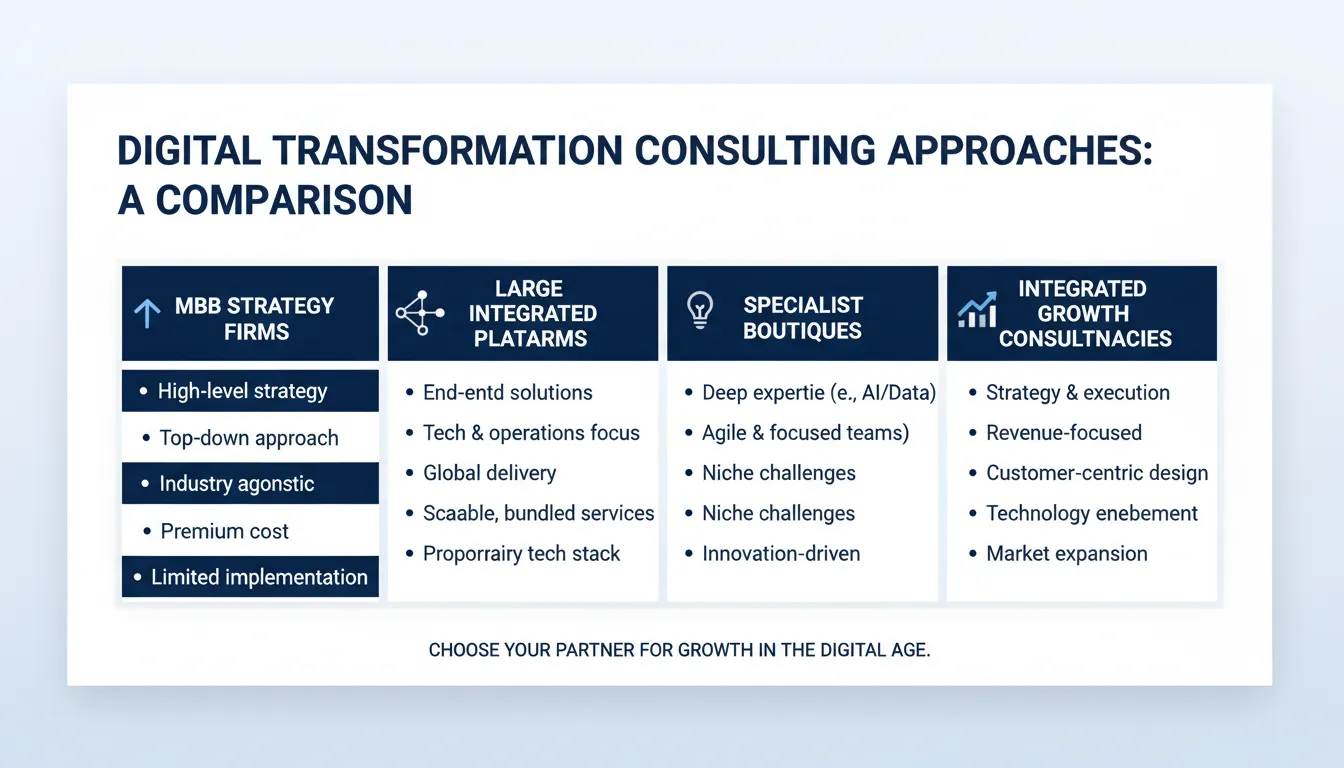
| Firm Type | Strengths | Limitations | Best For |
|---|---|---|---|
| MBB Strategy Firms (McKinsey, BCG, Bain) |
Unmatched strategic rigor, CEO-level problem framing, data analysis | Strategy-to-execution gap; recommendations handed off without implementation continuity | Front-end diagnostic and strategic direction for large enterprise programs |
| Large Integrated Platforms (Accenture Song, Deloitte Digital) |
Massive technology delivery scale, global coordination, systems integration | Standardized approaches rarely produce breakthrough competitive positioning | Large-scale technology rollouts across global operations |
| Specialist Boutiques (Prophet, Lippincott, Interbrand) |
Deep expertise in a specific discipline; sharper, more tailored deliverables | Limited scope; cannot address strategy, brand, and technology simultaneously | Focused engagements in brand, CX, or innovation where depth matters more than breadth |
| Integrated Growth Consultancies (Vivaldi and peers) |
Combines strategic rigor, creative excellence, and data mastery in one team | Smaller global headcount than MBB or Accenture-scale firms | Mid-market and enterprise organizations that need strategy and execution to move together |
MBB Strategy Firms: McKinsey, BCG, Bain
The elite strategy houses bring unmatched rigor in economics, data analysis, and CEO-level problem framing. Engagements tend to focus on strategic direction: where to play, how to win, what to stop doing. They are strongest at the front end of transformation, diagnosing problems and defining high-level strategy. The gap often appears in execution: recommendations handed off to internal teams or implementation partners who were not part of the strategic process. For transformations that require deep operational change, the handoff creates friction.
Large Integrated Platforms: Accenture Song, Deloitte Digital
Scale is the primary asset here. These firms offer technology delivery, systems integration, and implementation at a level no boutique can match. They are purpose-built for organizations that need massive, coordinated technology rollouts across global operations. The trade-off is differentiation. Transformation programs at this scale tend toward standardization, and standardized approaches rarely produce breakthrough competitive positioning.
Specialist Boutiques: Prophet, Lippincott, Interbrand
Specialist firms bring deep expertise in a specific dimension of transformation, whether brand strategy, customer experience design, or innovation methodology. Their work is often sharper and more tailored than what larger firms deliver. The limitation is scope: a boutique hired to redesign your brand architecture cannot also redesign your technology stack or your operating model.
Integrated Growth Consultancies: The Emerging Alternative
A newer category of digital transformation consulting firms bridges all three. These integrated consultancies combine the strategic rigor of MBB with the creative excellence of brand agencies and the data mastery of technology specialists. The result is transformation work that is simultaneously analytically grounded, brand-consistent, and executable. For mid-market and enterprise organizations that need strategy and execution to move together, this model often delivers more lasting results than any single-discipline approach.
Vivaldi Group operates in this integrated space. The firm’s model deliberately combines competitive strategy, brand innovation, and AI-powered analytics into a single, coordinated practice. The goal is not a recommendation document. It is measurable, sustained transformation.
What to Expect From a Digital Transformation Consulting Engagement
Enterprise digital transformation does not happen in a single sprint. The most effective programs move through four distinct phases, each building on the last. Understanding this arc before signing a contract is the difference between a managed transformation and a reactive one.
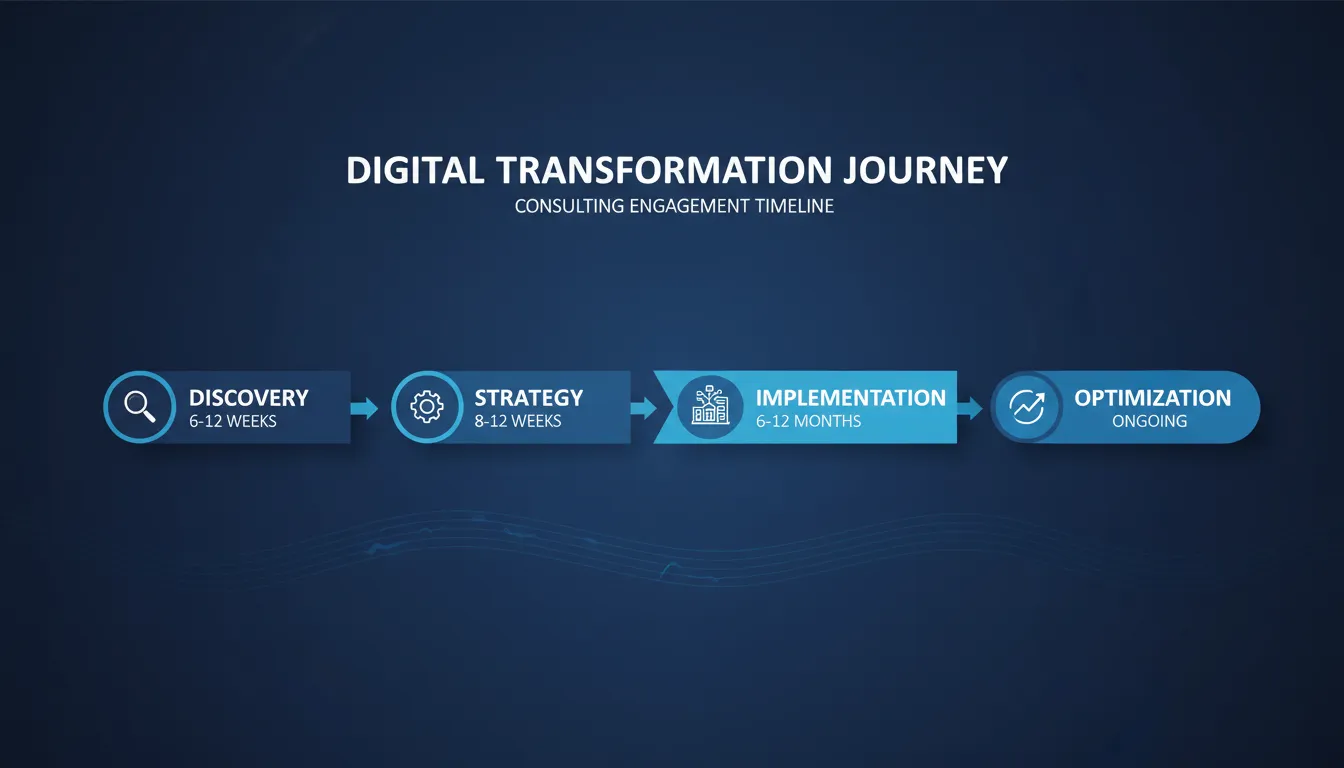
Phase 1: Discovery and Diagnosis (6 to 12 Weeks)
Every transformation engagement should begin with a rigorous assessment of the current state. This phase surfaces the gaps between where the organization is and where it needs to go. Expect your consulting partner to conduct stakeholder interviews, analyze competitive dynamics, evaluate digital maturity across business functions, and map existing customer journeys against evolving market expectations.
The deliverable is a clear picture of the highest-leverage transformation opportunities, ranked by potential value and implementation complexity. A partner who skips this phase and moves straight to recommendations is selling a pre-packaged solution, not a customized strategy.
Phase 2: Strategy Development (8 to 12 Weeks)
Strategy development translates the diagnostic findings into a transformation roadmap. This phase defines the future state: the business model changes, the customer experience innovations, the technology investments, and the organizational capabilities required to compete. It should also address brand strategy, because digital transformation without brand alignment creates confusion for customers, employees, and partners alike.
Look for consulting firms that can demonstrate how their strategic recommendations connect to financial outcomes. Growth strategies that cannot be traced to revenue or margin impact are interesting ideas, not transformation blueprints. Vivaldi’s approach to growth strategy and innovation explicitly links strategic choices to measurable business value from day one.
Phase 3: Implementation and Activation (6 to 12 Months)
This is where most transformation programs fail. Strategy firms that lack implementation capabilities hand off to internal teams who were not part of the strategic process. The vision loses fidelity. Priorities shift. Momentum stalls. The organizations that sustain transformation are the ones that keep strategy and execution in close proximity throughout the implementation phase.
What this looks like in practice: cross-functional consulting teams working alongside internal stakeholders, not handing off to them. Regular review cycles that connect implementation progress to strategic intent. Organizational enablement programs that prepare employees for new ways of working, not just new tools.
Phase 4: Optimization and Scaling (Ongoing)
Enterprise digital transformation is not a project with an end date. The organizations that gain the most from transformation treat it as a continuous operating capability, not a one-time initiative. The consulting relationship should evolve from implementation support to performance optimization: measuring outcomes, identifying new opportunities, and scaling what is working.
How to Evaluate Digital Transformation Consulting Firms
The selection process for a digital transformation consulting partner should be as rigorous as the transformation itself. Six criteria separate partners who deliver lasting change from those who deliver interesting reports.
1. Methodology Depth and Proprietary Frameworks
Generic frameworks produce generic strategies. The firms worth partnering with have developed their own proprietary methodologies through years of research and client work. Ask every candidate: What is your core methodology? How was it developed? What evidence do you have that it produces better outcomes than standard approaches?
Vivaldi’s Interaction Field Model, for example, reimagines how companies create value by shifting from linear value chains to dynamic participant ecosystems. It is not a repackaged consulting framework. It is a research-grounded methodology for building businesses that generate compounding value through network effects, virality, and continuous learning.
2. Integration Across Disciplines
Digital transformation touches strategy, brand, technology, culture, and operations simultaneously. A consulting firm that can only address one or two of these dimensions will force you to manage coordination between multiple partners. That coordination cost, in time and organizational energy, is higher than most leaders account for when they choose a specialist.
Test integration by asking candidates to describe a recent engagement where strategy, brand, and technology decisions had to be made in sequence. How did they manage the interdependencies? Who made the integrating decisions? Firms with true digital platforms and ecosystems capability alongside strategy can demonstrate this in concrete terms.
3. Sector and Market Expertise
Enterprise digital transformation looks different in financial services than in consumer goods, and different again in healthcare or technology. Consulting firms that can demonstrate deep sector knowledge bring pattern recognition that accelerates the diagnostic phase and reduces implementation risk. Ask for case references in your specific industry, not general capability demonstrations.
4. AI Strategy Credibility
AI is no longer a future consideration for enterprise transformation. It is an immediate capability question. Research by McKinsey suggests that while 75% of large organizations have adopted AI tools, fewer than 10% report meaningful business impact. The gap between adoption and impact is a strategy and implementation problem, not a technology problem. Evaluate candidates on how they think about AI as a business value amplifier. Firms still positioning AI primarily as cost reduction are behind the curve. Look for partners who can show demonstrated capability in AI, new technology, and data solutions as strategic differentiators, not just operational tools.
5. Thought Leadership and Evidence Base
The best consulting firms contribute original ideas to the fields they practice in. Look for published research, books, frameworks cited by other practitioners, and speaking records at senior executive forums. Thought leadership is not a vanity indicator. It signals that the firm is advancing its methodology, not just applying yesterday’s thinking to today’s problems.
6. Engagement Model Flexibility
Not every transformation program requires a 24-month engagement. The strongest partners offer modular engagement structures that can begin with a focused assessment and scale into a full transformation program if the early work validates the investment. Firms that only sell large, multi-year retainers from the outset have a revenue model, not a client-first model.
Evaluating digital transformation consulting firms and want a benchmark framework? Connect with Vivaldi’s team for a structured assessment of your current consulting landscape and where the gaps are.
Five Red Flags When Evaluating Digital Transformation Consulting Firms
Choosing the wrong partner for enterprise digital transformation is an expensive mistake. These warning signs appear in the evaluation process before the contract is signed.
- They lead with technology, not strategy. Technology enables transformation. It does not define it. A consulting firm that opens with its technology platform or software relationships before understanding your business problem has the cause and effect reversed.
- Their references are all from implementation, not strategy. Ask for references from clients who evaluated multiple strategic options. If a firm can only demonstrate delivery capability, not strategic judgment, it is an implementation partner, not a transformation partner.
- They cannot quantify past client outcomes. Every credible digital transformation consulting firm tracks the business results of its work: revenue impact, market share gain, customer acquisition cost reduction, brand equity improvement. Vague claims about “significant transformation” are not evidence.
- Their team rotates after the pitch. The consultants who win the business should be the consultants who do the work. If the senior partners who presented your proposal are absent from the engagement team, ask why before signing.
- They skip the diagnostic phase. Firms that arrive with pre-built transformation frameworks and fill in client names after the fact are selling products, not delivering transformation. The diagnosis should drive the strategy, not the other way around.
How to Measure ROI on Digital Transformation Consulting
Return on investment for enterprise digital transformation is multi-dimensional. Tracking only cost savings or technology adoption rates misses the larger value creation that effective transformation programs unlock. The most sophisticated organizations set ROI measurement frameworks in the strategy phase, before implementation begins, so baselines are established and success criteria are agreed upon before a single dollar is spent on execution.
Short-Term Indicators (0 to 12 Months)
- Time-to-market for new digital capabilities and products
- Employee adoption rates for new tools and processes
- Customer satisfaction scores across digitally transformed touchpoints
- Reduction in operational friction and process cycle times
Medium-Term Indicators (12 to 36 Months)
- Revenue attributable to new digital channels or business models
- Customer acquisition cost reduction from improved digital experience
- Brand equity movement in target segments
- Competitive win rate in markets where transformation is most visible
Long-Term Indicators (36 Months and Beyond)
- Market share gains in categories where digital capability is a purchase driver
- Organizational capability improvements, measured by internal talent retention and recruitment
- Platform and ecosystem effects: participant growth, network value, learning velocity
- Brand premium: the price and preference advantage that accrues to organizations with strong, transformation-aligned brands
Vivaldi’s AI innovation capabilities practice helps organizations build the measurement infrastructure to track these outcomes from day one, so the ROI conversation is grounded in data rather than assumption.
Why the Integrated Model Changes Everything
The deepest flaw in most enterprise digital transformation programs is not a technology failure. It is a coherence failure. Strategy says one thing. Brand communicates another. Technology enables a third. Customers experience a gap between all three, and that gap erodes the value that the transformation was supposed to create.
The integrated model addresses this directly. When strategy, brand, and technology decisions are made by the same team, in the same room, using the same data, coherence is not a coordination challenge. It is a structural outcome. The brand strategy informs the technology roadmap. The technology roadmap shapes the customer experience. The customer experience feeds back into the competitive strategy. The system compounds on itself.
This is what Vivaldi’s clients mean when they describe transformation programs that “stuck.” The changes did not erode over time, because they were not layered on top of existing structures. They were embedded into the operating model, the brand identity, and the technology infrastructure simultaneously. That is the difference between transformation and renovation. Vivaldi’s cultural transformation practice ensures the human side of change keeps pace with the structural and technological shifts.
For organizations evaluating how to position digital transformation as a competitive advantage, not just an operational upgrade, the question is not which consulting firm has the largest headcount. It is which firm has the integrated capability to make strategy, brand, and technology move in the same direction, at the same time, toward the same goal. Explore how Vivaldi connects business strategy and transformation into a unified practice built for lasting impact.
If your organization is ready to move beyond renovation thinking and into genuine transformation, reach out to Vivaldi’s team to discuss what an integrated engagement could look like.
Frequently Asked Questions About Digital Transformation Consulting
What does a digital transformation consulting firm actually do?
A digital transformation consulting firm helps organizations redesign their strategy, operations, brand, and technology capabilities to compete in a digital-first environment. Engagements typically begin with a diagnostic assessment, move into strategy development, and proceed through implementation and ongoing optimization. The scope ranges from business model redesign and customer experience innovation to AI integration and organizational capability building. The most effective firms integrate strategy, brand, and technology into a unified transformation program rather than treating them as separate workstreams.
How long does a digital transformation consulting engagement take?
For enterprise organizations, digital transformation consulting engagements typically span 6 to 24 months for core programs, with ongoing optimization relationships extending for years. The timeline depends on scope: a focused brand and digital strategy engagement might run 12 to 16 weeks, while an enterprise-wide transformation covering strategy, technology, and organizational change typically requires 12 to 24 months of sustained work. Modular engagement models allow organizations to begin with an assessment phase and scale the relationship as confidence builds.
How much does digital transformation consulting cost for enterprise organizations?
Investment ranges vary significantly by scope and firm type. MBB strategy engagements for enterprise digital transformation typically start at $500K and can reach $5M or more for multi-phase programs. Integrated consultancies generally work in a $250K to $2M range depending on program scope. The cost of choosing the wrong partner, through a failed implementation or a strategy that cannot be executed, usually far exceeds the cost difference between premium and mid-market firms. Focus evaluation on demonstrated outcomes rather than day rates.
What is the difference between digital transformation consulting and IT consulting?
IT consulting focuses on technology systems: software implementation, infrastructure, cybersecurity, and systems integration. Digital transformation consulting addresses a broader strategic agenda: how the organization creates value, competes for customers, and builds capabilities in a digital economy. Technology is a critical enabler within digital transformation, but the strategic questions about business model design, brand positioning, customer experience, and organizational change require a different kind of expertise than IT advisory alone.
How do I choose between a large consulting firm and a specialist boutique for digital transformation?
Large firms offer scale and broad implementation capability. Specialist boutiques offer depth in a specific discipline. The better question is whether you need a single firm that can integrate strategy, brand, and technology, or whether you are comfortable managing coordination across multiple specialist partners. For organizations that have tried the multi-vendor model and found the coordination cost too high, integrated consultancies that combine strategic rigor, creative capability, and technology expertise in a single practice often deliver faster, more coherent outcomes.
What should I ask a digital transformation consulting firm before hiring them?
Ask for their proprietary methodology and the evidence base behind it. Ask for client references in your specific industry where they can quantify business outcomes. Ask how they handle the integration between strategy, brand, and technology decisions. Ask who will actually work on your engagement, not just who will present the proposal. Ask how they define success and what measurement framework they would use to evaluate progress. Firms that give clear, specific answers to all five questions are worth deeper evaluation. Firms that respond with generalities are selling a pitch, not a partnership.
Choosing a Digital Transformation Consulting Partner: The Bottom Line
Enterprise digital transformation is one of the highest-stakes decisions a leadership team makes. The firms that navigate it successfully share a common pattern: they chose partners who could connect strategy to execution, brand to technology, and ambition to measurable outcomes.
The market for digital transformation consulting firms is crowded with options. The differentiator is not headcount, geography, or brand recognition. It is the ability to hold strategy, brand, and technology in a single, integrated program that compounds value over time rather than fragmenting it across separate workstreams.
If your organization is evaluating digital transformation consulting firms and wants to understand what the integrated model delivers in practice, contact Vivaldi’s team to start the conversation. The diagnostic is where every transformation begins. The quality of that conversation tells you more about a consulting firm’s value than any proposal document ever will.